
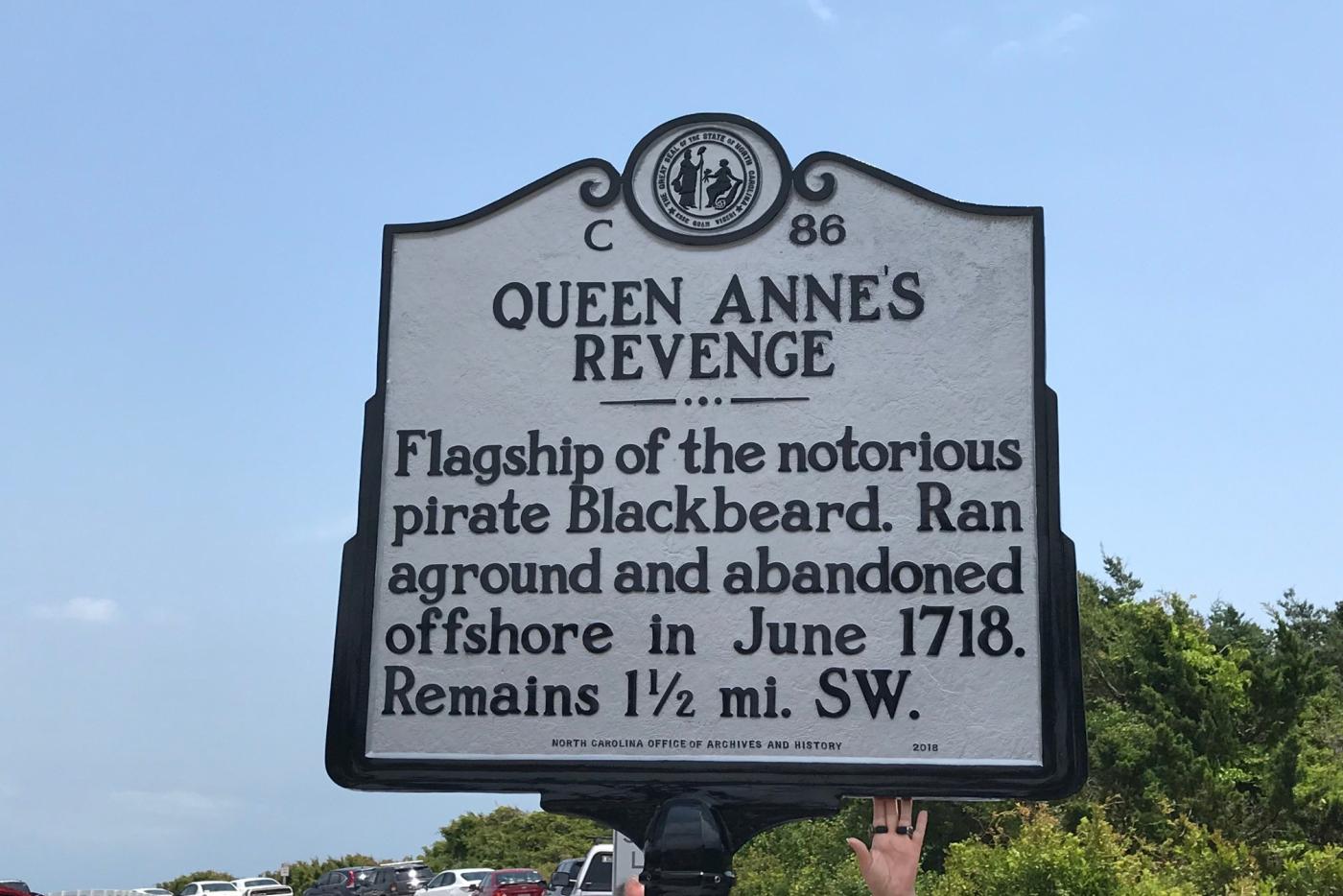
Location: SR 1190 (Fort Macon Road) a little outside of the parking lot at Fort Macon State Park
County: Carteret
Original Date Cast: 2017
County: Carteret
Original Date Cast: 2017
In June 1718, a fleet of four pirate sailing vessels, under the overall command of the notorious pirate Blackbeard (Edward Thatch), attempted to sail into the then named Topsail Inlet (now Beaufort Inlet). One of the vessels was the ship Queen Anne’s Revenge. There were also three sloops, Adventure, Revenge, and a small Spanish sloop previously captured by the pirates near Havana.
In the early eighteenth century there was no deep water dredged inlet to enter Beaufort Harbor as there is today. Early maps show that the inlet could be just 12 feet at low tide and 16 feet at high tide. Wimble’s map (1738) shows a narrow channel, just 100 feet or so wide, and about 17 feet deep which vessels had to navigate into Beaufort’s harbor.
The three sloops successfully sailed through the inlet, but the much larger ship Queen Anne’s Revenge (QAR), ran aground on a sand-bar, on the shoals outside the inlet. Blackbeard ordered the captain of the sloop Adventure, to sail back into the ocean and assist QAR, but it also then ran aground at about a “gun-shot” distance from the ship. Both vessels were abandoned. Blackbeard took the small Spanish sloop, eight guns, forty white and sixty black men, and sailed away. He abandoned some of the other pirates onshore, on what is now Bogue Banks, where they would have perished if they had not then been taken on board Revenge, whose captain was the pirate Stede Bonnet.
When it ran aground and was abandoned at Beaufort Inlet, Queen Anne’s Revenge had only been Blackbeard’s flagship for a little over six months. The vessel was before that a French slave trade vessel, La Concorde, that was taken by the pirates on November 28, 1717 near the Caribbean island of Martinique, at the end of its Middle Passage. So far researchers have traced the history of La Concorde back to 1710, and records for four voyages of the ship owned by Nantes merchant René Montaudouin, have been found. One voyage was as a privateer in 1710–1711 during the War of Spanish Succession (1701–1714). Two slave trade voyages were completed in 1713–1714 and 1715–1716. In March 1717, La Concorde departed Nantes, again as a slave ship.
The events of its 1717 voyage, including its being taken by pirates under the command of “Edouard Titche anglais” were recorded in various contemporary reports and letters. These include depositions made by La Concorde’s captain, Pierre Dosset, and her first lieutenant, François Ernaud, on their return to France (without the ship), as well as in correspondence between Martinique’s Governor Feuquières, the island’s intendant, Mesnier, and the ship’s outraged owner, René Montaudouin, following its loss to English pirates.
La Concorde’s slave trade voyage of 1717, started from Nantes, France on March 24. For the voyage, the ship was armed with sixteen cannon and had a crew of seventy-five. The vessel made port on July 8 at Juda, or Whydah, in modern-day Benin where they loaded 516 enslaved Africans on board along with twenty pounds of gold dust. Departing Juda on October 9, La Concorde navigated toward Martinique. On November 28, only 100 miles from its destination, they encountered Blackbeard and his fellow pirates. The pirates took the ship along with several La Concorde crew members, and left the remaining crew members and their captives on an island. The pirates left the French one of their smaller sloops, with which they completed their voyage, and transfer of enslaved Africans to Martinique.
Blackbeard then cruised the Caribbean in search of prizes for the rest of 1717 and part of the following year. In April 1718, he added to his fleet by taking Captain David Herriot's sloop Adventure in the Bay of Honduras. The following month, the pirates arrived off Charleston, South Carolina and preyed on ships entering or leaving the port. While there, Blackbeard held the crew and passengers of the Crowley hostage and ransomed them for a chest of medicine to treat his crew. After receiving the medicine and returning the hostages, Blackbeard and his fleet continued north and arrived off Old Topsail (now Beaufort) Inlet in June 1718. There Queen Anne’s Revenge ran aground and was abandoned. A letter from Captain Ellis Brand of the British naval ship HMS Lyme, a guard vessel patrolling the Virginia-Carolinas coastline to the Board of the Admiralty is the last known recorded sighting of the grounded vessel.
Blackbeard met his fate just six months later, on November 22, 1718, at Ocracoke Inlet, at the hand of an armed contingent sent by Virginia Governor Alexander Spotswood, and led by Royal Navy Lieutenant Robert Maynard. Since then, Blackbeard, has become such a celebrity that his popularity surpasses that of other more prominent historical figures. People know his name worldwide, but much of what is widely accepted as fact is shrouded in myth. Researchers are still trying to determine who he was, and where he originally came from. In contemporary documents Blackbeard is sometimes named as Edward Thatch, but also as T’ache or Teach. In records of Stede Bonnet’s trial he is referred to as Edward Thatch. Edward Thatch (Blackbeard), was probably from Bristol, England, but other sources claim Jamaica, Philadelphia, and London to be his point of origin. Researchers believe Blackbeard operated as a privateer during Queen Anne's War (1701-1714) and became a pirate after the war's conclusion.
Following its wrecking, the remains of his flagship, Queen Anne’s Revenge soon sank beneath the sea and sediments of the Atlantic Ocean where they remained unseen for almost three hundred years. In November 1996, Intersal Inc., discovered the shipwreck in Beaufort Inlet, using information provided to Operations Director Mike Daniel by company president Phil Masters. Designated as shipwreck site 0003BUI, (now 31CR314), the shipwreck was suspected to be the remains of Queen Anne’s Revenge, flagship of the most notorious figure of the Golden Age of Piracy, Blackbeard.
On March 3, 1997, the North Carolina Department of Cultural Resources designated the site, all related artifacts, and surrounding sea floor within 300 yards of the site, a protected area to preserve the remains. The site was listed on the National Register of Historic Places in 2004. The Department’s Office of Archives and History is responsible for the shipwreck protection, preservation, management, and investigation. Since the 1996 discovery, the North Carolina Underwater Archaeology Branch, with assistance from numerous organizations and partners, has conducted intensive historical and archaeological work on the site, as resources have been available.
References:
Lawrence, Richard, and Mark U. Wilde-Ramsing, “In Search of Blackbeard: Historical and Archaeological Research at Shipwreck Site 0003BUI,” Southeastern Geologist (2001): 1-9
Moore, David D. “Blackbeard the Pirate: Historical Background and the Beaufort Inlet Shipwrecks,” Tributaries 7 (1997), 31–35
Moore, David D., and Mike Daniel, 2001, Blackbeard’s Capture of the Nantaise Slave Ship La Concorde: A Brief Analysis of the Documentary Evidence. Tributaries 11 (2001), 14–31.
Wilde-Ramsing, Mark U. “Steady as She Goes . . . A Test of the Gibbs’ Model Using the Queen Anne’s Revenge Shipwreck Site.” Ph.D. dissertation, East Carolina University, 2009.
Wilde-Ramsing, Mark U., and Linda F. Carnes-McNaughton, Blackbeard’s Sunken Prize: The 300-Year Voyage of Queen Anne’s Revenge (2018)
In the early eighteenth century there was no deep water dredged inlet to enter Beaufort Harbor as there is today. Early maps show that the inlet could be just 12 feet at low tide and 16 feet at high tide. Wimble’s map (1738) shows a narrow channel, just 100 feet or so wide, and about 17 feet deep which vessels had to navigate into Beaufort’s harbor.
The three sloops successfully sailed through the inlet, but the much larger ship Queen Anne’s Revenge (QAR), ran aground on a sand-bar, on the shoals outside the inlet. Blackbeard ordered the captain of the sloop Adventure, to sail back into the ocean and assist QAR, but it also then ran aground at about a “gun-shot” distance from the ship. Both vessels were abandoned. Blackbeard took the small Spanish sloop, eight guns, forty white and sixty black men, and sailed away. He abandoned some of the other pirates onshore, on what is now Bogue Banks, where they would have perished if they had not then been taken on board Revenge, whose captain was the pirate Stede Bonnet.
When it ran aground and was abandoned at Beaufort Inlet, Queen Anne’s Revenge had only been Blackbeard’s flagship for a little over six months. The vessel was before that a French slave trade vessel, La Concorde, that was taken by the pirates on November 28, 1717 near the Caribbean island of Martinique, at the end of its Middle Passage. So far researchers have traced the history of La Concorde back to 1710, and records for four voyages of the ship owned by Nantes merchant René Montaudouin, have been found. One voyage was as a privateer in 1710–1711 during the War of Spanish Succession (1701–1714). Two slave trade voyages were completed in 1713–1714 and 1715–1716. In March 1717, La Concorde departed Nantes, again as a slave ship.
The events of its 1717 voyage, including its being taken by pirates under the command of “Edouard Titche anglais” were recorded in various contemporary reports and letters. These include depositions made by La Concorde’s captain, Pierre Dosset, and her first lieutenant, François Ernaud, on their return to France (without the ship), as well as in correspondence between Martinique’s Governor Feuquières, the island’s intendant, Mesnier, and the ship’s outraged owner, René Montaudouin, following its loss to English pirates.
La Concorde’s slave trade voyage of 1717, started from Nantes, France on March 24. For the voyage, the ship was armed with sixteen cannon and had a crew of seventy-five. The vessel made port on July 8 at Juda, or Whydah, in modern-day Benin where they loaded 516 enslaved Africans on board along with twenty pounds of gold dust. Departing Juda on October 9, La Concorde navigated toward Martinique. On November 28, only 100 miles from its destination, they encountered Blackbeard and his fellow pirates. The pirates took the ship along with several La Concorde crew members, and left the remaining crew members and their captives on an island. The pirates left the French one of their smaller sloops, with which they completed their voyage, and transfer of enslaved Africans to Martinique.
Blackbeard then cruised the Caribbean in search of prizes for the rest of 1717 and part of the following year. In April 1718, he added to his fleet by taking Captain David Herriot's sloop Adventure in the Bay of Honduras. The following month, the pirates arrived off Charleston, South Carolina and preyed on ships entering or leaving the port. While there, Blackbeard held the crew and passengers of the Crowley hostage and ransomed them for a chest of medicine to treat his crew. After receiving the medicine and returning the hostages, Blackbeard and his fleet continued north and arrived off Old Topsail (now Beaufort) Inlet in June 1718. There Queen Anne’s Revenge ran aground and was abandoned. A letter from Captain Ellis Brand of the British naval ship HMS Lyme, a guard vessel patrolling the Virginia-Carolinas coastline to the Board of the Admiralty is the last known recorded sighting of the grounded vessel.
Blackbeard met his fate just six months later, on November 22, 1718, at Ocracoke Inlet, at the hand of an armed contingent sent by Virginia Governor Alexander Spotswood, and led by Royal Navy Lieutenant Robert Maynard. Since then, Blackbeard, has become such a celebrity that his popularity surpasses that of other more prominent historical figures. People know his name worldwide, but much of what is widely accepted as fact is shrouded in myth. Researchers are still trying to determine who he was, and where he originally came from. In contemporary documents Blackbeard is sometimes named as Edward Thatch, but also as T’ache or Teach. In records of Stede Bonnet’s trial he is referred to as Edward Thatch. Edward Thatch (Blackbeard), was probably from Bristol, England, but other sources claim Jamaica, Philadelphia, and London to be his point of origin. Researchers believe Blackbeard operated as a privateer during Queen Anne's War (1701-1714) and became a pirate after the war's conclusion.
Following its wrecking, the remains of his flagship, Queen Anne’s Revenge soon sank beneath the sea and sediments of the Atlantic Ocean where they remained unseen for almost three hundred years. In November 1996, Intersal Inc., discovered the shipwreck in Beaufort Inlet, using information provided to Operations Director Mike Daniel by company president Phil Masters. Designated as shipwreck site 0003BUI, (now 31CR314), the shipwreck was suspected to be the remains of Queen Anne’s Revenge, flagship of the most notorious figure of the Golden Age of Piracy, Blackbeard.
On March 3, 1997, the North Carolina Department of Cultural Resources designated the site, all related artifacts, and surrounding sea floor within 300 yards of the site, a protected area to preserve the remains. The site was listed on the National Register of Historic Places in 2004. The Department’s Office of Archives and History is responsible for the shipwreck protection, preservation, management, and investigation. Since the 1996 discovery, the North Carolina Underwater Archaeology Branch, with assistance from numerous organizations and partners, has conducted intensive historical and archaeological work on the site, as resources have been available.
References:
Lawrence, Richard, and Mark U. Wilde-Ramsing, “In Search of Blackbeard: Historical and Archaeological Research at Shipwreck Site 0003BUI,” Southeastern Geologist (2001): 1-9
Moore, David D. “Blackbeard the Pirate: Historical Background and the Beaufort Inlet Shipwrecks,” Tributaries 7 (1997), 31–35
Moore, David D., and Mike Daniel, 2001, Blackbeard’s Capture of the Nantaise Slave Ship La Concorde: A Brief Analysis of the Documentary Evidence. Tributaries 11 (2001), 14–31.
Wilde-Ramsing, Mark U. “Steady as She Goes . . . A Test of the Gibbs’ Model Using the Queen Anne’s Revenge Shipwreck Site.” Ph.D. dissertation, East Carolina University, 2009.
Wilde-Ramsing, Mark U., and Linda F. Carnes-McNaughton, Blackbeard’s Sunken Prize: The 300-Year Voyage of Queen Anne’s Revenge (2018)