
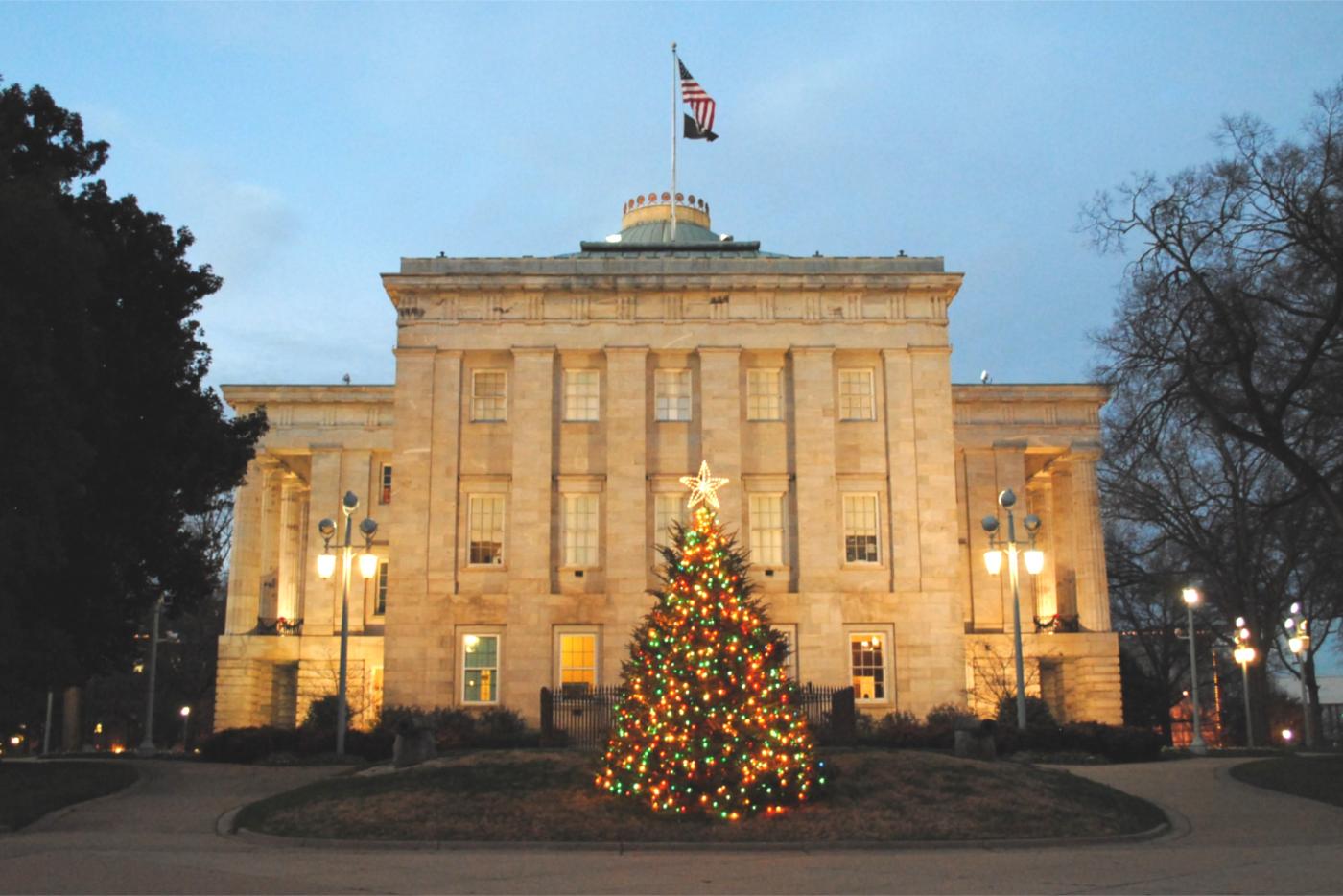
Join the North Carolina State Capitol and Governor Josh Stein for the annual tree-lighting tradition on Tuesday, Dec. 1. The State Capitol is administered by the Division of State Historic Sites within the N.C. Department of Natural and Cultural Resources (DNCR).
The lighting of the State Christmas Tree at the Capitol is considered the official start of the holiday season in the Tar Heel State. The festivities will begin on Capitol Square at 5:30 p.m. with luminaries and holiday music performed by the Raleigh Concert Band. The governor and dignitaries will make their way to the south grounds just after 6 p.m. to officially begin the ceremony. The lit tree will be visible the length of Fayetteville Street. This year, State Employees’ Credit Union will provide refreshments on the south plaza – and even Santa is scheduled to make an appearance!
Following the ceremony, visitors are invited into the Capitol and the Executive Mansion to experience the holiday decorations and hear performances by local musicians. The Capitol is open 6:30-7:30 p.m. and the Executive Mansion will welcome guests from 6-9 p.m.
The State Christmas tree, a real Fraser fir, comes to the Capitol from the mountains of North Carolina. This year, the State Tree is sponsored by State Employees’ Credit Union.
The Capitol will host a Holiday Open House with live music in the rotunda Dec. 3-5 from 10 a.m.-4 p.m. Other sponsors of the holiday festivities include the State Capitol Foundation, the Division of State Historic Sites and the N.C. Department of Administration-Facility Management.
All Capitol events are free, and reservations are not needed or accepted. For additional information, please call (984) 867-8340. The State Capitol is located at 1 East Edenton St. in downtown Raleigh.
About the North Carolina Department of Natural and Cultural Resources
The N.C. Department of Natural and Cultural Resources (DNCR) manages, promotes, and enhances the things that people love about North Carolina – its diverse arts and culture, rich history, and spectacular natural areas. At more than 100 sites across the state, the department enhances education, stimulates economic development, improves public health, expands accessibility, and strengthens community resiliency. For more information, please visit www.dncr.nc.gov.