
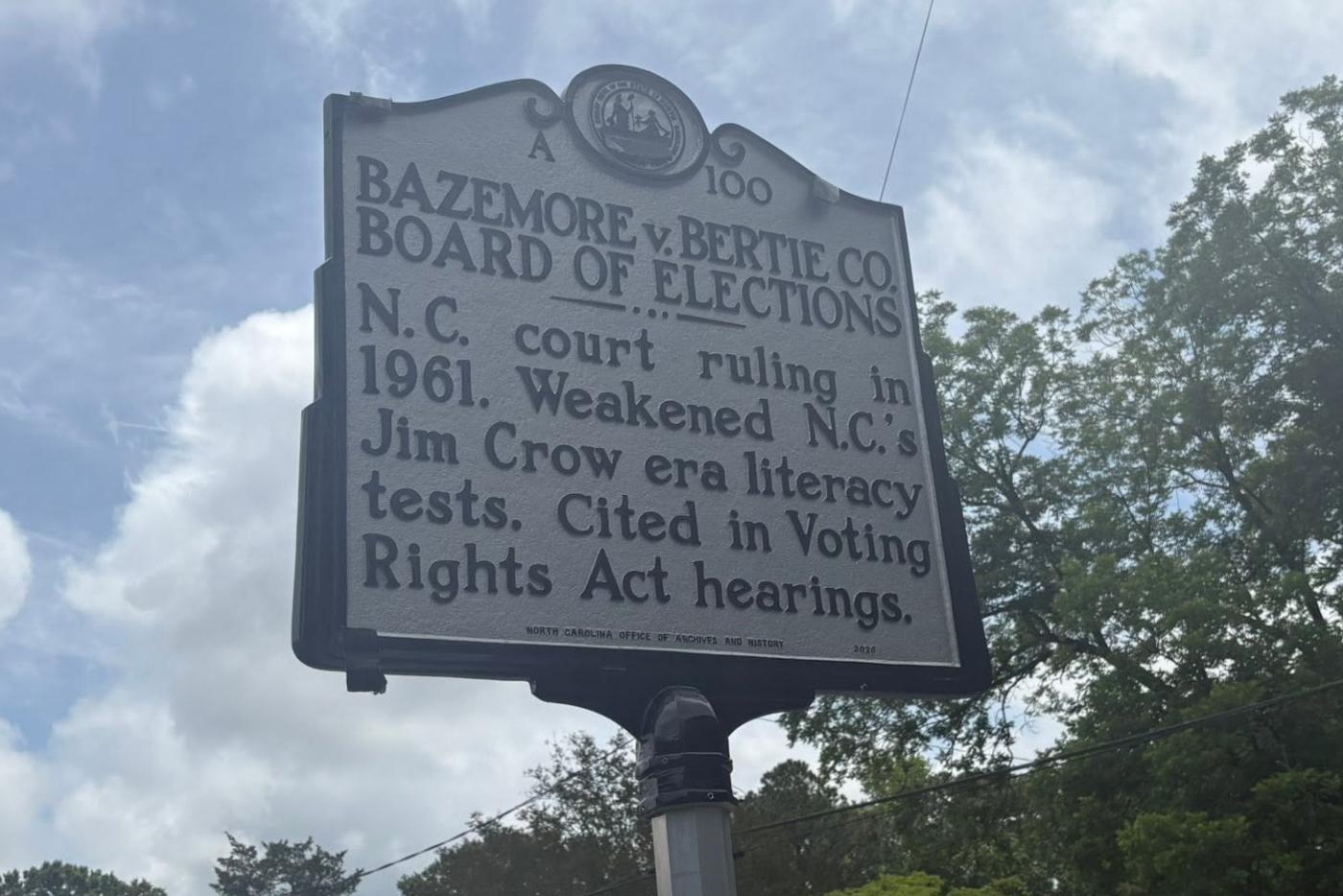
Location: West Watson Street and Sterlingworth St (NC 308) in Windsor
County: Bertie
Original Date Cast: 2026
In May 1960, Nancy Bazemore, a 47-year-old African American resident of Bertie County, walked into the Woodville precinct to register to vote. What followed was a legal battle that would reach the North Carolina Supreme Court and reshape voting rights across the state.
Bertie County's racial demographics told a stark story. Black residents outnumbered white residents by a three-to-two ratio, yet registered white voters outnumbered registered Black voters by nearly nine to one. That disparity was no accident. County registrars maintained it through the literacy test, a tool created in the late nineteenth century specifically to disenfranchise Black voters across the South. In Woodville, the test took the form of dictation: a registrar read aloud from the state constitution while applicants transcribed what they heard, and spelling errors counted against them. The North Carolina attorney general had declared such spelling-based dictation tests illegal as recently as March of that year. Bertie County ignored the ruling. Bazemore received a failing grade and was denied registration.
She appealed immediately. At her hearing a week later, her attorney, James R. Walker Jr., an Ahoskie native and University of North Carolina School of Law graduate, announced that Bazemore refused to submit to another dictation test. When the board rejected her appeal, Walker continued fighting, ultimately bringing the case before the North Carolina Supreme Court.
Walker's brief was pointed and thorough. He argued that the literacy test as administered in Bertie County was unconstitutional under the state constitution's separation of powers clause, because it effectively granted legislative authority to local election officials. He documented that the dictation requirement was applied exclusively to Black applicants. He also identified the test's inherent vulnerabilities to abuse: a registrar's pronunciation, reading speed, a voter's hearing or speech patterns, and the registrar's own discretion in grading could all determine the outcome, with little accountability.
In April 1961, the court ruled in Bazemore's favor. Though the justices declined to find bad faith on the part of Bertie County officials, they found the test as administered unreasonable and beyond legal intent. More significantly, the court established statewide standards: applicants must receive legible copies of the constitution, grading must reflect reasonable proficiency rather than perfection, and test length could not be used to obstruct other applicants from registering.
The significance of Bazemore extended beyond Bertie County. Federal civil rights reports and subsequent voting rights discussions cited the case as evidence of the burden of literacy tests imposed on Black residents.
References:
“Aid Sought for Court Appeal: Residents of 4 Counties to Push for Registration.” Norfolk Journal and Guide, October 15, 1960, 14.
Bazemore v. Bertie County Board of Elections, 119 S.E.2d 637 (N.C. 1961). Available on Justia.
Bertie County BoardElectionsFeiss, Owen M. “Gaston County v. United States: Fruition of the Freezing Principle.” Supreme Court Review (1969): 379–445.
Fleming, John W. “Carolina News Digest: Favorable Decision.” Norfolk Journal and Guide, April 22, 1961, 9.
Keech, William R., and Michael P. Sistrom. “Implementation of the Voting Rights Act in North Carolina.” Social Science Working Paper 790. Pasadena: California Institute of Technology, 1992.
Leloudis, James L., and Robert R. Korstad. Fragile Democracy: The Struggle Over Race and Voting Rights in North Carolina. Chapel Hill: University of North Carolina Press, 2020.
“Literacy Test Spelled Out.” Charlotte Observer, April 13, 1961, 7.
“Negroes Claim Rights Denied.” Rocky Mount Telegram, May 20, 1960, 1.
“Negroes File 7 Protests.” Charlotte Observer, May 20, 1960, 4.
Joyner, Irving. Testimony Before the Subcommittee on Elections of the U.S. House Committee on Administration. April 18, 2019.
United States Commission on Civil Rights. 1961 United States Commission on Civil Rights Report. Book 1: Voting. Washington, D.C.: Government Printing Office, 1961.
United States Commission on Civil Rights, North Carolina Advisory Committee. Equal Protection of the Laws in North Carolina: Report of the North Carolina Advisory Committee to the U.S. Commission on Civil Rights, 1959–1962. Washington, D.C., 1962.
Wertheimer, John W. Law and Society in the South: A History of North Carolina Court Cases. Lexington: University Press of Kentucky, 2009.
“Writing Not Needed.” Daily Press (Newport News, VA), April 13, 1961, 27.
“NC Constitutional Amendments: Legislature Approves Citizen‑Only Voting, Rejects Repeal of Jim Crow Literacy Test Law.” WRAL News, June 27, 2024.