
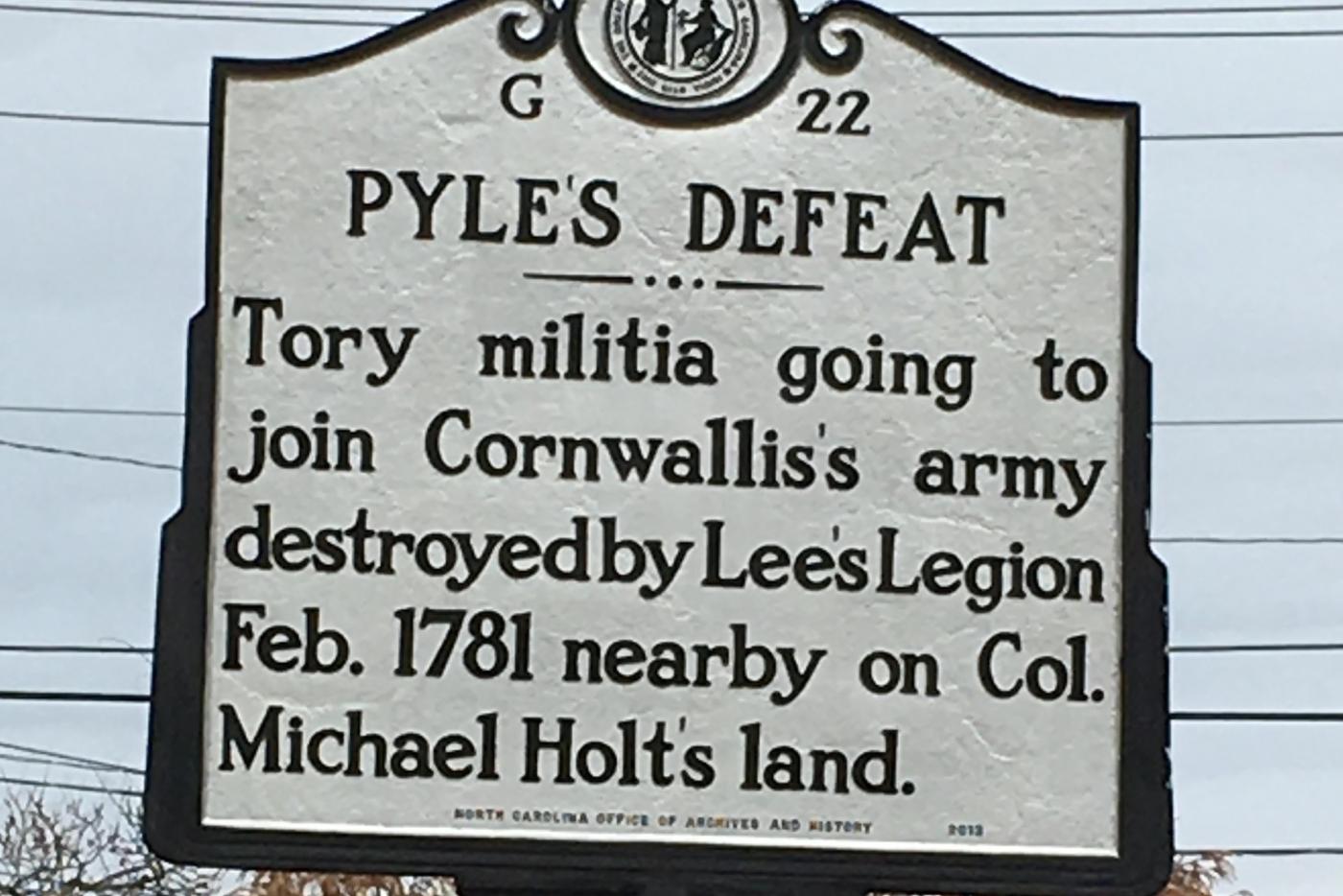
Location: NC 49 (Maple Avenue) at Anthony Road south of Burlington
County: Alamance
Original Date Cast: 1939
In January 1781, British Gen. Lord Charles Cornwallis began a campaign to catch Patriot Major Gen. Nathaniel Greene before he crossed the Dan River. Maj. Gen. Greene was able to stay just ahead of Lord Cornwallis and make his escape on February 14. Unable to cross the swollen river, the British turned south and headed to Hillsborough in hopes of raising Loyalist militia to bolster their numbers. On February 20th, the Royal Standard was raised in Hillsborough.
Very few Hillsborough Loyalists volunteered to join the British Army, leaving Lord Cornwallis greatly disappointed. The local Loyalists had suffered greatly at the hands of the Patriot militia. Many lost properties and many more were subjected to great cruelty. The result was a general fear and reluctance to come out and openly support the Crown. However, to the south of Hillsborough, in modern Alamance, Chatham, and Randolph Counties, Loyalists were far more plentiful and eager to join.
Dr. John Pyle had been a prominent Regulator who protested the rampant corruption in North Carolina’s local government in the late 1760 and early 1770’s. While the Regulator Rebellion was suppressed in 1771, the Regulators remembered the abuses they suffered at the hands of corrupt officials. Those corrupt officials also happened to be the leaders of the revolution in North Carolina. The former Regulators, like Dr. Pyle, tended to remain loyal to the Crown because of this. When Lord Cornwallis put out the call for Loyalists to join the British Army in Hillsborough, the old Regulators responded.
Dr. Pyle raised approximately three hundred Loyalist recruits. He requested an escort to safely conduct them to Hillsborough. Lt. Col. Banastre Tarleton, with two hundred British Legion Dragoons, one hundred and fifty Regulars, and one hundred Hessian Jaegers, was dispatched to meet him at Patriot Gen. John Butler’s plantation a few miles from Hillsborough on February 25. The day before the rendezvous, Patriot Col. Henry Lee learned about the plans and moved to intercept the Loyalists. Col. Lee’s men consisted of his 240-man American Legion, 50 North Carolina Dragoons, and more than 500 militia under Brig. Gen. Andrew Pickens. The American Legion Dragoons wore green coats very similar to those of the British Legion.
Dr. Pyle’s men, easily identified by their clean clothing and strips of red wool on the crowns of their hats, were mounted. However, they were not Dragoons and lacked swords. Most were armed with rifles. When the Loyalists encountered the green-coated Dragoons of the American Legion, they assumed they were Tarleton’s Legion. Col. Lee realized this and moved his men to the right side of the road, allowing the Loyalists to continue believing they were safe. The two groups marched past each other; the Legion’s swords were drawn but down on their right sides, hidden from view. Maj. Joseph Eggleston of the American Legion was at the end of the Legion line and unaware of the ruse. When the Loyalists reached the Major, he immediately attacked a man he thought was a Loyalist officer. All of Lee’s Dragoons immediately turned to the left and began hacking the shocked Loyalists down. The surprise was so complete, many of Dr. Pyle’s men cried out that the dragoons were killing their own men.
Prior to the meeting, Colonel Lee ordered his militia to stay out of sight and move into the trees on the left side of the road. This gave the Loyalists no escape route. While a small number of Loyalists were able to dismount and fire at the Patriots, their resistance was quickly ended with a charge by the dragoons. According to Patriot sources, the Patriot soldiers cut down any Loyalists who attempted to surrender. When Colonel Lee finally regained control and ended the slaughter, more than one hundred Loyalists lay dead on the ground. At least one hundred and fifty more were wounded. Capt. Joseph Graham related that the Patriot-allied Catawba Indians murdered seven or eight wounded Loyalists with spears well after the battle ended. Later that evening, another six prisoners were murdered by some of the American Legion Dragoons. None of the Patriots were killed or wounded.
The Patriots knew the British Legion was only a few miles away, so they moved out of the area as soon as possible. As they began to retreat, the Patriots made a wounded Loyalist guide them. This man, named Holt, lived nearby. Holt was still not aware that Lee’s Legion was not the British Legion, and he addressed Colonel Lee as Lt. Colonel Tarleton. He told Lee he had killed far more of his own men than they ever did of the Patriots. Colonel Lee yelled at Holt, saying if he called him Tarleton again, he would cut him down. Holt learned only then that the Loyalists had been attacked by Patriot soldiers.
The brutal defeat of the Loyalist recruits eliminated Lord Cornwallis’s hopes of local reinforcements. This impacted his ability to forage for supplies and hurt British and Loyalist morale. At the same time, it inspired the Patriots and drew more militia support for General Greene’s Army. This ensured the British were outnumbered more than two to one at the Battle of Guilford Courthouse just two and a half weeks later.
References:
Carole Troxler, Pyle's Defeat: Deception at the Racepath (2003).
Jeffrey Bright and Stewart Dunaway, Pyle’s Defeat (2011).
Ian Saberton (ed), The Papers of Lord Cornwallis Vol. IV (2010).
Ian Saberton. Cornwallis and the Winter Campaign, January – April 1781. Journal of the American Revolution. (2020).
Joseph Graham, General Joseph Graham and his Papers on North Carolina Revolutionary History. (1904).
George W. Troxler, John Pyle. NCpedia Entry. (1994) https://www.ncpedia.org/biography/pyle-john.