
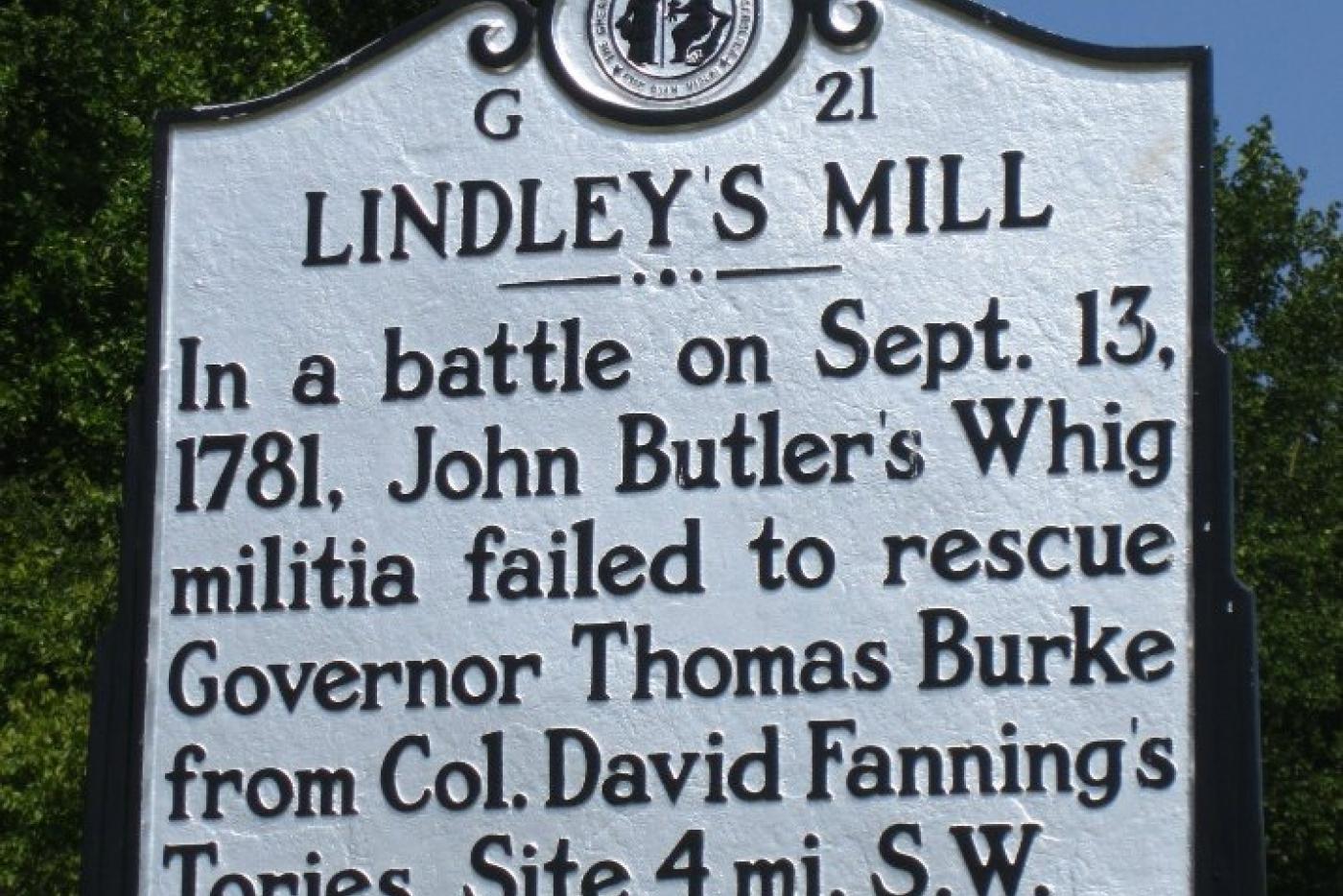
Location: NC 87 at SR 1005 (Greensboro-Chapel Hill Road) in Eli Whitney
County: Alamance
Original Date Cast: 1939
In the aftermath of Lord Charles Cornwallis’s campaign across North Carolina, fighting between Patriot and Loyalist militia intensified. In July 1781, one of the most effective Loyalist leaders, David Fanning, was promoted from Captain to Colonel of the Loyal Militia of Randolph and Chatham Counties by Major James Craig, commander of British-held Wilmington. Fanning soon took advantage of the lack of regular military authority in the piedmont to raid Patriot supply lines, local Patriot militias, and generally destabilize the Patriot government in North Carolina. Cox’s Mill, south of modern Ramseur, NC, was in the heart of Loyalists-dominated territory, and served as Fanning’s headquarters.
After two months of successful raids and skirmishes that included Chatham Courthouse and House in the Horseshoe, Fanning set his sights on Hillsborough, NC. His targets were newly elected Governor Thomas Burke and most of the General Assembly. He began gathering intelligence in the early part of September. Fanning was primarily concerned with the location of Patriot Brigadier General John Butler and other local militia groups.
Col. Fanning’s 435 men were reinforced by about 270 men commanded by Colonels Hector McNeil and Archibald McDugald on September 9. They advanced toward Hillsboro on the 11th. Along the way, Fanning detached thirty men to neutralize a group of Orange County Militia at New Hope Creek, to his southeast. In a heavy fog at 7AM on September 12, 1781, Colonel Fanning’s force surrounded Hillsboro and launched their attack. The surprise was so complete, the seventy-one soldiers of the 6th NC Continental Regiment with Governor Burke did not have a chance to react.
With only one man wounded, Fanning’s force killed fifteen, wounded twenty and secured more than 200 prisoners. The prisoners included Governor Burke, his council, several Continental Army officers and seventy-one soldiers. They also freed thirty Loyalists and British soldiers from the town jail. One of these prisoners was scheduled to be hung that day.
Colonel Fanning moved his men and prisoners out of town by noon. He needed to get to Wilmington as quickly as possible. They reached Cox’s Mill, eighteen miles to the south by dark. Brigadier General Butler learned of the attack by midday and began moving to intercept Fanning.
The Loyalists were on the march early on the 13th of September. Eight miles south, Brigadier General Butler moved his 400 men into an ambush position to the north of Lindley’s Mill, along the road to Alamance. His position was advantageous. The hilly terrain overlooking a road intersection at a ford in Cane Creek was ideal for the Patriots. Even though Butler was outnumbered two to one, the POWs put Fanning’s larger force at a severe disadvantage.
Unfortunately, Butler’s men opened fire too early. Their initial volley killed eight men, including Colonel McNeil. Fanning’s column was nearly three-quarters of a mile long, which meant the bulk of the force was free to react to the ambush. Colonel Fanning ordered the Loyalists to retreat, and the prisoners were secured in a nearby barn. Once they regrouped, the Loyalists organized the attack and moved west over the hills to hit Butler’s force on their side.
The battle was one of maneuvers rather than rapid fire. When the Loyalists counterattacked, Butler ordered a retreat. Col. Robert Mebane disobeyed the order and rallied the men, preventing a route of the Patriot forces. Pension applications of participants disagree about the length of the battle. Some say it took one hour, others up to four hours.
Both sides agreed that the battle ended when everyone ran out of ammunition. The Patriots lost approximately ninety men wounded, twenty-five dead, and ten captured. The Loyalists' losses were similar, but with no men captured. Col. David Fanning’s left arm was shattered by a musket ball late in the fight. He lost so much blood; his men expected him to die.
The Loyalists moved toward Wilmington with their prisoners. Brigadier General John Butler tried to recover the prisoners again at Brown’s Swamp, forty miles west of Wilmington. As at Lindley’s Mill, Butler was outmaneuvered. He ordered a retreat, which was countered by Colonel Mebane. One participant related that Mebane saved the entire force from being captured by the combined force of British and Loyalists.
Governor Burke and the other prisoners arrived in Wilmington on September 24, 1781. The governor complained about his condition during the retreat. He was hungry, dirty, and exhausted, just like his captors. Once in British hands, Governor Burke and the Continental officers were transferred to Charleston, SC. Major Craig wrote that Governor Burke must not be exchanged under any circumstances as he was “…capable of doing infinite mischief in [North Carolina]”. They were allowed to live freely on James Island on parole. Burke did not like his living conditions and escaped on January 16, 1782. He fled back to North Carolina but wrote to the British stating he still honored his parole.
Governor Burke did not, however, honor his parole. He resumed his duties as governor. Many North Carolinians, civilians and military, believed he broke his oath and dishonored himself. Alexander Martin succeeded him as governor in April 1782.
References:
David Fanning, Thomas Wynne (ed), The Narrative of Colonel David Fanning (1861)
John Hairr, Colonel David Fanning: The Adventures of a Carolina Loyalist (2000)
Nathaniel Greene, The Papers of General Nathaniel Greene, Vol IX (1997)
Patrick O’Kelley, Nothing But Blood and Slaughter, Vol III (2005)
Stuart Dunaways, Battle of Lindley’s Mill (2008)
Ian Saberton, The Cornwallis Papers, Vol VI (2010). Craig to Balfour, 22nd October, 1781.