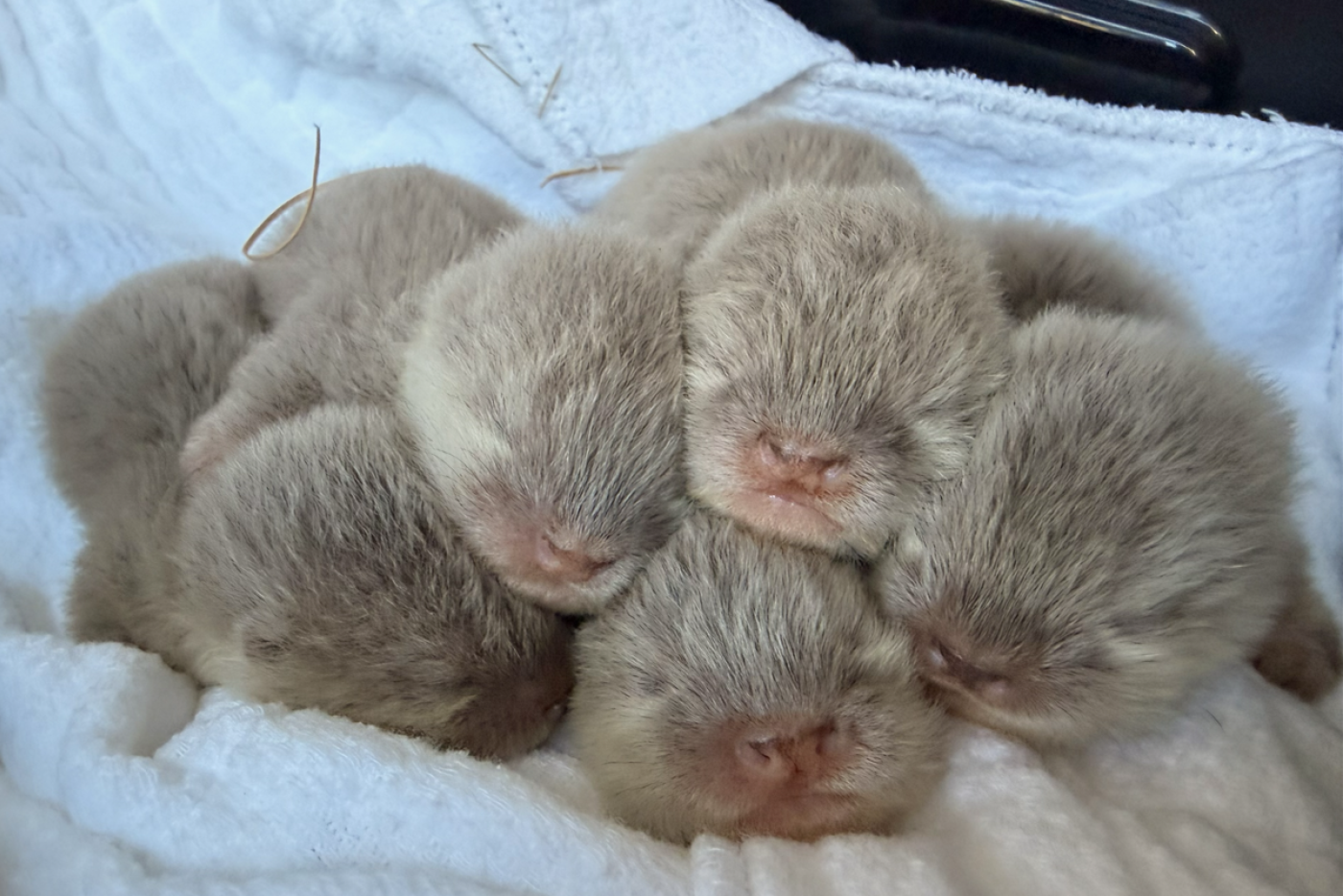
Five Asian small-clawed otter pups — four males and one female — were born Monday, Oct. 19, at the North Carolina Aquarium at Fort Fisher (NCAFF) to proud parents Milli and Binx, bringing the Aquarium's otter family to 10. The tiny new arrivals are healthy, gaining weight, and bonding closely with their parents and three older siblings. The Aquarium is part of the N.C. Department of Natural and Cultural Resources.
The otter care team had been closely monitoring Milli in anticipation of the births. On the morning of Oct. 19, otter keeper Kristen Upton was watching the pair’s nesting box when she began hearing unfamiliar chirps coming from the behind-the-scenes den. What initially sounded like three newborns turned out to be five.
“We were delighted when we first heard three distinct pup chirps coming from the nest — and even more thrilled when we discovered five healthy pups,” said Upton. “Now that we’ve been able to examine the pups, we’re excited to see that each one is gaining weight and the entire family is bonding well.”
This is the second litter for Milli and Binx, whose first three pups — Nyx, Bohdi, and Baloo — were born Dec. 5, 2025. The older siblings have been offering food to Milli and assisting with nest construction — skills they learned from Binx. When both parents are away from the nest, one of the siblings often remains behind to watch over the pups.
The newborns weighed approximately 82 to 91 grams each at birth, roughly the weight of a medium lemon. For now, the family of ten will remain behind the scenes under the close monitoring of the otter care team.
The five pups also represent an important addition to the conservation breeding program for a species facing declining populations in the wild.
Milli, 8, arrived at Fort Fisher in January 2024 from Hong Kong, where she was born to parents who were confiscated by the Hong Kong Agriculture, Fisheries and Conservation Department. Binx, 6, joined her in fall 2024 from an Association of Zoos and Aquariums (AZA) facility in Florida as a mate for Milli.
Asian small-clawed otters are the smallest otter species in the world, native to parts of South and Southeast Asia. They are listed as vulnerable on the International Union for Conservation of Nature's Red List of Threatened Species, with population numbers declining due to residential and commercial development, deforestation, the illegal pet trade, pollution, climate change, and poaching.
While the Aquarium at Fort Fisher is closed for its renovation and expansion, the public can follow the growing otter family on the NCAFF social media platforms including Facebook, Threads and Instagram.
###
About the North Carolina Aquarium at Fort Fisher
The North Carolina Aquarium at Fort Fisher is just south of Kure Beach, a short drive from Wilmington on U.S. 421 and less than a mile from the Fort Fisher ferry terminal. The Aquarium is one of three Aquariums and a pier that make up the North Carolina Aquariums, a division of the Department of Natural and Cultural Resources. While NCAFF is closed for a transformative renovation and expansion, visitors are encouraged to stroll into Discovery Bay at Independence mall, a complimentary experience or reserve their tickets at NCA Pine Knoll Shores and NCA Roanoke Island or to visit Jennette’s Pier for some great fishing. The mission of the North Carolina Aquariums is to inspire care and conservation of nature by connecting people with the aquatic world.
About the North Carolina Department of Natural and Cultural Resources
The N.C. Department of Natural and Cultural Resources (DNCR) manages, promotes, and enhances the things that people love about North Carolina — its diverse arts and culture, rich history, and spectacular natural areas. At more than 100 sites across the state, the department enhances education, stimulates economic development, improves public health, expands accessibility, and strengthens community resiliency. For more information, please visit www.dncr.nc.gov.
About the North Carolina Aquarium Society
The North Carolina Aquarium Society is the nonprofit partner organization of the North Carolina Aquariums, celebrating 50 years of connecting people with the wonders of aquatic life. NCAS raises private funds to champion the Aquariums and enhance the aquarium experience for all visitors. The private support raised by NCAS ensures the Aquariums can support their priorities – opening new habitats, nurturing aquatic life, and facilitating educational programs and conservation research.