
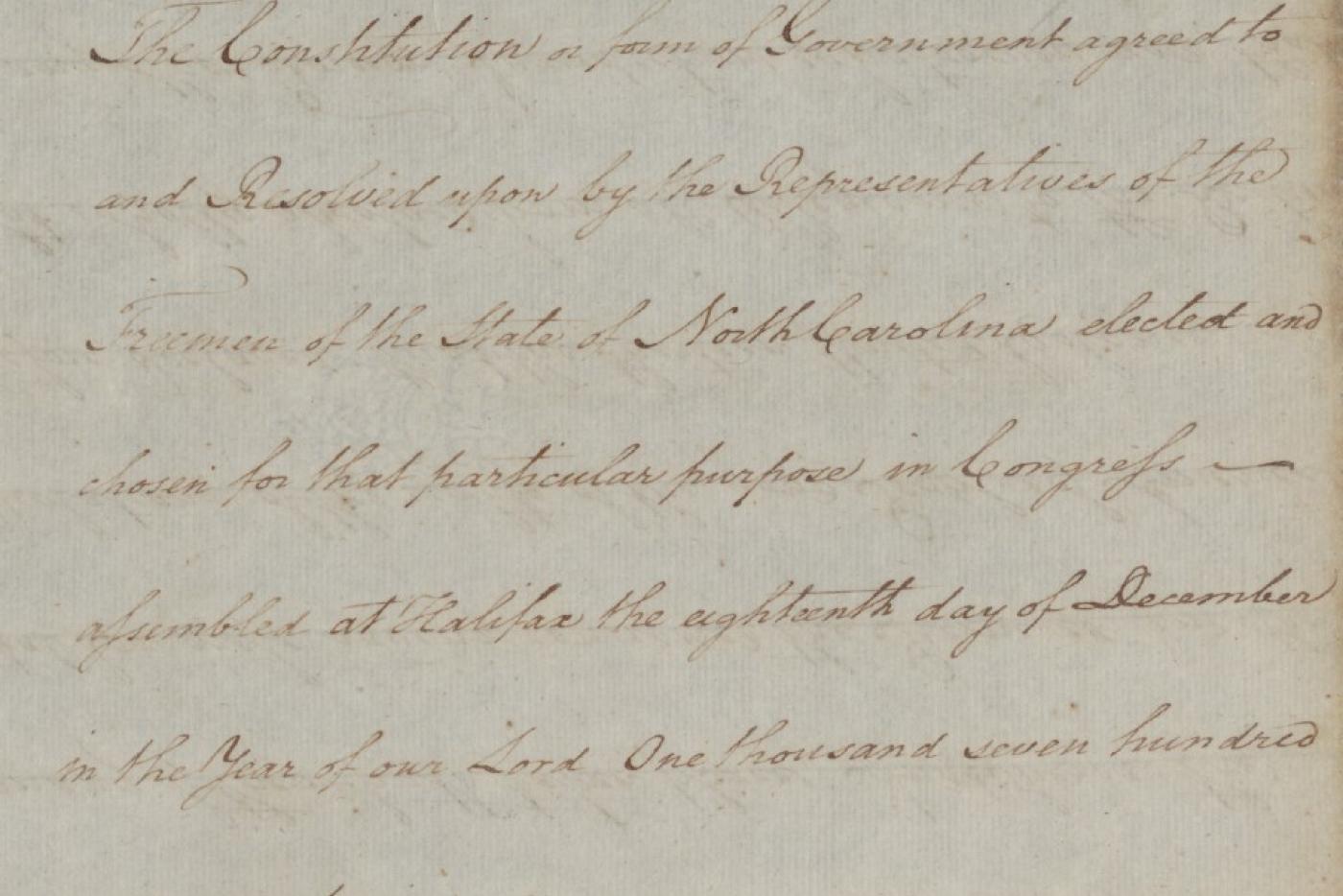
The State Archives, a division of the North Carolina Department of Natural and Cultural Resources (DNCR), will showcase original state constitutional documents with a July 4 exhibition, “To Preserve the Blessings of Liberty,” at the State Capitol. The display is part of the Capitol 250: NC Freedom Fest, July 4, 10 a.m.-4 p.m.
As one of 13 original states, North Carolina will celebrate its 250th birthday this year, along with that of the United States. The July 4 exhibit will showcase the first North Carolina Constitution, ratified on Dec. 18, 1776, and the state’s Declaration of Rights, alongside John Adams’s “Thoughts on Government” letter to William Hooper, one of North Carolina’s three signers of the Declaration of Independence. Adams’s guidance in March 1776 profoundly influenced the new state government. Exhibit panels and staff will discuss ways the North Carolina Constitution has changed over time including the current constitution, third in the state’s history and ratified in 1971.
Additional documents on display include:
• the 1868 North Carolina Constitution, written during Reconstruction with the state’s first “Black Caucus” of 13 African American delegates at the Constitutional Convention
• a 1777 draft broadside of the Articles of Confederation, the document that established the United States’ federal government.
• a 1787 broadside edition of the U.S. Constitution, debated in the state’s General Assembly
For more information, contact Adrienne Berney, adrienne.berney@dncr.nc.gov; 919-814-6863.
About the State Archives
The State Archives serves as the custodian of North Carolina's historical records, preserving and providing public access to a wealth of archival materials. Through its diverse collections, educational programs, and exhibitions, the State Archives plays a crucial role in promoting an understanding and appreciation of North Carolina's rich historical legacy.
About the North Carolina Department of Natural and Cultural Resources
The N.C. Department of Natural and Cultural Resources (DNCR) manages, promotes, and enhances the things that people love about North Carolina – its diverse arts and culture, rich history, and spectacular natural areas. At more than 100 sites across the state, the department enhances education, stimulates economic development, improves public health, expands accessibility, and strengthens community resiliency. For more information, please visit www.dncr.nc.gov.