
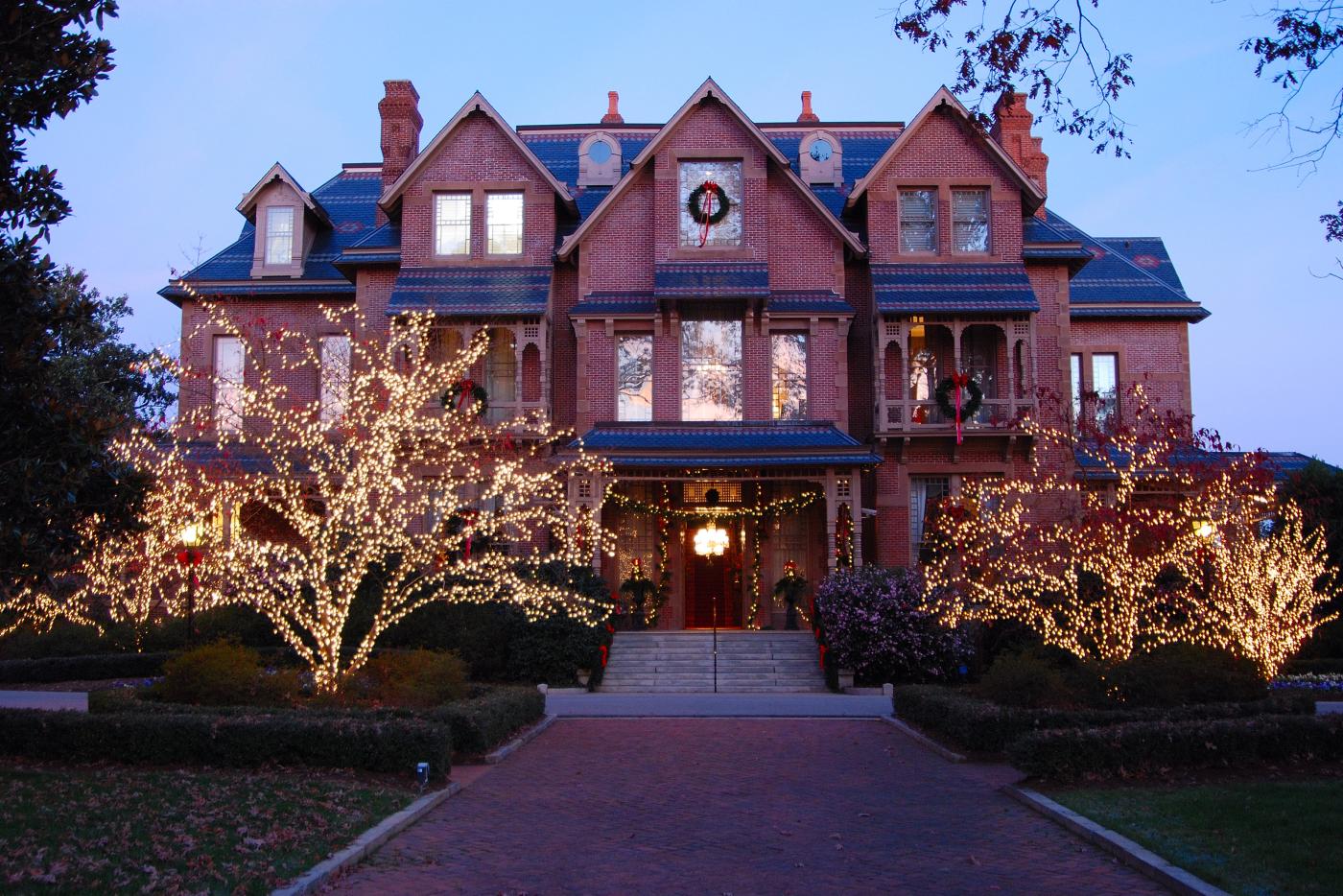
North Carolina’s Executive Mansion, the “people’s house,” will open its historic doors again for the beloved annual Holiday Open House Dec. 11-13. The Open House hours are Thursday, Dec. 11, 6-9 p.m.; Friday, Dec. 12, 10 a.m.-5 p.m.; and Saturday, Dec. 13, 10 a.m.-5 p.m.
Admission is free and reservations are not needed or accepted. Visitors should enter at the main gates on Blount Street.
While guided tours are not offered during the Open House, knowledgeable docents will be stationed in each room to answer questions and share details about the mansion and its holiday décor. Please note that public access is limited to the house only, as the gardens are closed for the season.
During the Open House, donations of nonperishable food will be accepted for the Food Bank of Central & Eastern North Carolina. No monetary donations will be accepted.
The fine Victorian-style mansion, home to North Carolina governors since 1891, was once described by President Franklin Delano Roosevelt as having “the most beautiful governor’s residence interior in America.” Built from native materials, the Executive Mansion has been occupied by 30 governors’ families. The Executive Mansion is located at 200 N. Blount St., Raleigh, NC 27601. Governor Josh Stein is the 31st governor to live in the mansion and the 76th governor of North Carolina since statehood.
About the North Carolina Department of Natural and Cultural Resources
The N.C. Department of Natural and Cultural Resources (DNCR) manages, promotes, and enhances the things that people love about North Carolina – its diverse arts and culture, rich history, and spectacular natural areas. Through its programs, the department enhances education, stimulates economic development, improves public health, expands accessibility, and strengthens community resiliency.
The department manages over 100 locations across the state, including 27 historic sites, seven history museums, two art museums, five science museums, four aquariums, 35 state parks, four recreation areas, dozens of state trails and natural areas, the North Carolina Zoo, the State Library, the State Archives, the N.C. Arts Council, the African American Heritage Commission, the American Indian Heritage Commission, the State Historic Preservation Office, the Office of State Archaeology, the Highway Historical Markers program, the N.C. Land and Water Fund, and the Natural Heritage Program. For more information, please visit www.dncr.nc.gov.