
We Who Believe in Freedom Teacher's Guide
We Who Believe in Freedom: The Life and Times of Ella Baker
Teacher’s Guide by Dr. Nievel Stanisclaus
with contributions from Dr. Lea E. Williams, Author
The Civil Rights Movement wasn’t just a moment in history, it was a movement that helped shape American society. The Civil Rights Movement gave voice to the plight of enslaved Africans who for decades before fought racial oppression. A spirit of activism swept through communities during the mid-1950s to the 1960s bringing together men, women, and children who would fight against the marginalization of the African American community, and against inequality, segregation, discrimination, economic, education, health, and wealth disparities.
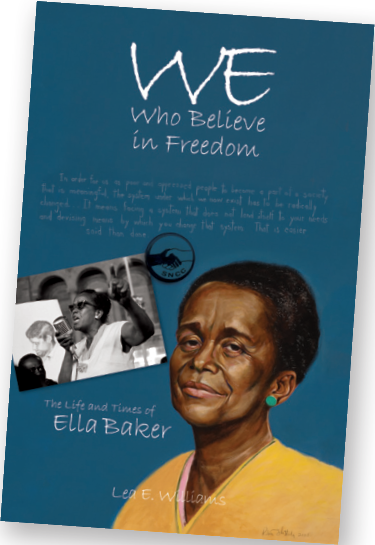
We Who Believe in Freedom: The Life and Times of Ella Baker by Dr. Lea E. Williams, tells the poignant story of Ella Baker as she sought to unlock the leadership potential in all who encountered her. Ella Baker embodied a spirit of activism. A home-grown hero with a big story to share, Ella passionately believed in and worked tirelessly to see justice for all persons and to see everyone enjoy the freedoms that were promised within the Constitution of this great nation. The book captures the reader’s attention and brings the reader into an understanding of the complex yet significant contributions Ella Baker made to the Civil Rights Movement and the nation.
This Teacher Plan provides dynamic learning activities that capture the students’ attention and allow them to proficiently demonstrate their ability to connect prior knowledge and experience with new learning. Before introducing students to We Who Believe in Freedom: The Life and Times of Ella Baker, teachers should provide background information about the Civil Rights Movement and share with students pictures and other appropriate and approved documents to help them build core knowledge of the period in which Ella Baker rose to prominence. Teachers, it is best to develop a timeline or plan that would allow students time to read the book in its entirety.
Desired Outcomes
By using this plan students will be able to connect the contributions of Ella Baker critically and analytically to events in North Carolina and the nation.
Compelling Question
What impact did Ella Baker have on the changes and developments in North Carolina and American society?
Supporting Questions
- What significant contributions did Ella Baker make to our understanding of the Civil Rights Movement and American society?
- How can we use the experiences of Ella Baker to better understand the changes that have occurred in American society?
- How does Ella Baker help us understand how the use of power and authority have led to changes in modern society?
- How did Ella Baker’s family upbringing, community, and schooling influence her commitment to civil rights and social justice?
- What values guided Baker in deciding how she would live her life and what jobs she would pursue?
- How did Baker navigate the limitations others tried to impose on her because of her gender?
Getting Started
Warm-Up/Discussion Activities
Using the “I Think, I Wonder” model, generate discussions among students as they record what they think the book will be about and what they might learn, things they want to know and questions they might have. Consider asking students to keep a Rolling Journal to record their responses to the supporting questions as they read the book:
- What significant contribution did Ella Baker make to our understanding of the Civil Rights Movement and American society?
- How can we use the experiences of Ella Baker to better understand changes that have occurred in American society?
- How does the life of Ella Baker help us understand how the use of power and authority have led to changes in American society?
- How did Ella Baker’s family upbringing, community, and schooling influence her commitment to civil rights and social justice?
- What values guided Baker in deciding how she would live her life and what jobs she would pursue?
- How did Baker navigate the limitations others tried to impose on her because of her gender?
Active Learning
These activities allow students to creatively engage in learning and reflect on the global impact of the life, experiences, and contributions of Ella Baker.
- Students can do a Think-Pair-Share to discuss and answer the following questions:
- How did Ella Baker’s family upbringing, community, and schooling influence her commitment to civil rights and social justice?
- What values guided Ella Baker in deciding how she would live her life and what jobs she would pursue?
- Students will complete any of the following activities to demonstrate their learning as they respond to the supporting questions.
- Story Board: Students create a one-page story board in which they depict Ella Baker’s early life. Students will illustrate how Ella Baker’s upbringing, community, and education influenced her commitment to civil rights and social justice.
- Pictogram: Students will create a one-page poster illustrating how Ella Baker’s experiences contributed to their understanding of the changes that have occurred in American society.
- Instagram Post: How does one person have such a profound impact in shaping a movement and nation at large? Create a social media post that captures the brilliance and impact Ella Baker had on society.
- Podcast: Students will reflect on their learning about the life and times of Ella Baker, creating a two-to-three-minute segment in which they explore the impact of Ella Baker on the Civil Rights Movement and the changes that occurred in American society.
- News Brief: Who was Ella Baker? Why is she a civil rights icon? Why did her life have such a profound impact on American society? Students will create an award-winning news brief answering these questions and any other questions that the teacher adds. Students should include important quotes and references to the text to support their ideas.
- Flipbook: During her youth, Ella Baker was a remarkable woman who worked tirelessly for an economically and socially just society. Students will create a Flipbook Magazine in which they provide pictures and informational text about Ella Baker’s early life, her career as a civil rights activist, and a special feature piece in which students examine the impact Ella Baker had on the Civil Rights Movement and the nation.
- To demonstrate understanding and to critically analyze the contributions of Ella Baker students will complete a Document Based Question assessment. Students will respond to the compelling question: What impact did Ella Baker have on the changes and developments in North Carolina and American society? Students will use the Rolling Journal to help in drafting their response.
The North Carolina Standard Course of Study (NCSCOS) guided the development of this planner.
Middle & High School Reading Standards for Literature
Key Ideas and Evidence
RL.7.1 Analyze text to identify where information is explicitly stated and where inferences must be drawn.
RL.7.2 Identify events in a text that are related to the theme.
RL.7.3 Determine how two or more story elements are related.
RL.9-10.1 Cite strong and thorough textual evidence to support analysis of what the text says explicitly as well as inferences drawn from the text.
Craft and Structure
RL.7.4 Determine the meaning of words and phrases as they are used in a text; determine how different word choices would change the meaning.
RL.7.5 Differentiate between a poem and other types of text.
RL.7.6 Compare the points of view of two or more characters or narrators in a text.
RL.9-10.4 Determine the meaning of words and phrases as they are used in the text; analyze the cumulative impact of specific word choices on meaning and tone.
RL.9-10.5 Analyze how an author’s choices concerning how to structure a text, order events within it, and manipulate time create effects such as mystery, tension, or surprise.
RL.9-10.6 Analyze a particular perspective or cultural experience reflected in a work of literature from outside the United States, drawing on a wide reading of world literature.
Integration of Ideas and Analysis
RL.7.7 Compare a text version of a story or poem with a video or live version of the same text.
RL.7.9 Compare a fictional character in a text with the same character portrayed in a historical account.
RL.9-10.7 Analyze the representation of a subject or a key scene in two different artistic mediums, including what is emphasized or absent in each treatment.
RL.9-10.9 Analyze how an author adopts or adapts source material in a specific work.
Range of Reading and Level of Complexity
RL.7.10 Actively engage in reading for the purpose of connecting prior knowledge and experiences to text for sustained periods of time.
RL.9-10.10 By the end of grade 9, read and understand literature within the 9–10 text complexity band proficiently and independently for sustained periods of time. Connect prior knowledge and experiences to text. By the end of grade 10, read and understand literature at the high end of the 9–10 text complexity band proficiently and independently for sustained periods of time. Connect prior knowledge and experiences to text.
Middle & High School Standards for Social Studies
Behavioral Science
7.B.1 Understand how individual and group values and beliefs have influenced various cultures.
7.B.1.1 Compare major elements of culture in various modern societies around the world.
7.B.1.2 Explain how values and beliefs affect human rights, justice, and equality for different groups of people.
7.B.1.3 Compare how individuals and groups respond to stereotypes, oppression, human rights violations, and genocide.
8.B.1 Analyze the impact of group behavior on the development of North Carolina and the nation.
AH.B.1 Evaluate American identity in terms of perspective, change, and continuity.
Civics & Government
7.C&G.1 Analyze modern governmental systems in terms of conflict and change.
7.C&G.1.1 Explain how the power and authority of various types of governments have created conflict that has led to change.
7.C&G.1.4 Summarize new ideas that changed political thought in various nations, societies, and regions.
8.C&G.1 Understand how democratic principles have influenced the government structure and policies of North Carolina and the nation.
AH.C&G.1 Evaluate the relationship between the American people and the government in terms of freedom, equality, and power.
AH.C&G.2 Analyze the American political system in terms of conflict, compromise, and consequence.
History
7.H.1 Evaluate historical and current events from a variety of perspectives.
7.H.1.1 Distinguish specific turning points of modern world history in terms of lasting impact.
7.H.1.2 Summarize the influence women, indigenous, racial, ethnic, political, and religious groups have had on historical events and current global issues.
8.H.1 Understand the role of conflict and cooperation in the development of North Carolina and the nation.
AH.H.1 Understand the reasons for American involvement in conflicts and the domestic and foreign impacts.
AH.H.3 Analyze various turning points in American history in terms of perspective, causation, and change.
Resource List
Library of Congress. Civil Rights History Project.
Library of Congress. Voices of Civil Rights. Online Exhibition.
Video. “Ella Baker: A Legacy of Grassroots Leadership—Nationals” (9:59)
Women & The American Story. Life Story: Ella Baker (1903–1986).
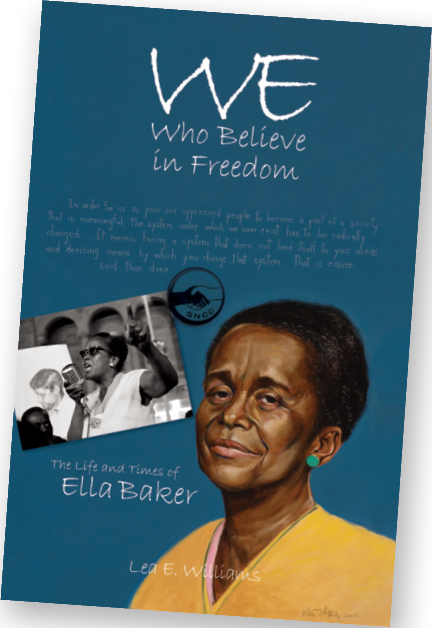
104 pp., 5.25 x 8, 15 color plates, 20 halftones, index
Paperback ISBN:
978-0-8652-6488-5
Published: November 2017
E-book PDF ISBN:
979-8-8908-5642-5
Published: November 2017
E-book EPUB ISBN:
978-0-8652-6475-5
Published: November 2017
Published by
North Carolina Office of Archives and History