NCHC resolutions feedback
From: Koonts, Sarah <sarah.koonts@ncdcr.gov>
Sent: Tuesday, February 28, 2023 9:32 AM
To: Waters, Darin <darin.waters@ncdcr.gov>
Subject: RE: NC Historical Commission Resolutions
Darin,
My management team and I didn’t have a lot of capacity to explore many ideas, and I didn’t receive any specific input from them. I think perhaps the main idea I would put forward would be that DNCR prioritize the development of an OAH educational team or at least an educational lead. We have a variety of capacities to manage the development of educational resources across your divisions, and I think we could use some leadership on directions, priorities, and communication on ways we can better coordinate our efforts across OAH (or at least identify capacity for coordination). That office or position may also be useful in setting priorities informal educational opportunities (online, in person and on demand programs).
On a lower level, I think a good idea is additional development of resources that are primary source based (in artifacts, documents, buildings).
Thanks, SEK
Ideas for Enhanced Educational Opportunities in the Field of History
As requested by the North Carolina Historical Commission
Offered by the Division of Historical Resources
February 2023
Overarching observations:
- A structural knowledge of the history of the nation and the state is sorely needed, but current curricula and competing educational priorities “hurry” that effort, and students may see it largely as a “memorize dates” or chronological exercise.
- We should as much or more so concentrate on educating and engaging the student (or adult) not at all interested in history (or doesn’t know they should be) as concentrating on the students and teachers interested in history.
- Our efforts should not be limited to history curriculum, but rather how to “bake in” history in a variety of ways both within and outside of the classroom.
- We have to use creative as well as tried and true means.
- No one is ever too old to learn North Carolina history, so educational opportunities should extend from ages 5 to 100!
| Initiative | Description |
|---|---|
| Participatory Approaches | |
| Create Youth Advisory Committee to NC Historical Commission and NCDNCR |
|
| Create History Teacher Advisory Committee to NC Historical Commission and NCDNCR |
|
| Foster “Speakers’ Bureau” and Mentoring Group within Agency |
|
| Job Shadowing Program |
|
| Collect Oral Histories of North Carolinians by youth in every county |
|
| Foster more historic trades’ training opportunities in North Carolina high schools and North Carolina Community Colleges |
|
| Preserve America Youth Summit participation |
|
| Consider History contests outside of History Day |
|
| More funding / scholarships for North Carolina History Day |
|
| Story Boards on State Trails |
|
| Geocaching State Historic Sites or Trails |
|
| Greater availability of North Carolina Historical Review in middle and high schools |
|
| Genealogy as a tool |
|
| INSTITUTIONAL APPROACHES | |
| Consider how to foster greater cooperation between NCDNCR and DPI |
|
| Restructure Agency Education Team with dedicated OAH team with steering committee format |
|
| Establish Standing Work Group within Agency for Traveling Exhibit Creation |
|
| Create primary source materials / bibliographies for each state historic site, park |
|
| Continue children’s book series for DNCR parks and historic sites |
|
| CURRICULA APPROACHES | |
| “Mine” DPI History curricula against Highway Historical Marker topics |
|
| Primary Source Lesson Plans |
|
| Combine STEM subjects with history (especially archaeology and conservation) |
|
| Teacher academy / summer workshops for history teachers (best practices / tips) |
|
| MEDIA APPROACHES | |
| “Re-run” This Day in North Carolina History segments |
|
| Q&A “How Come?” film series |
|
| Start “Milk Carton” History Campaign |
|
| “Lucy Worsley style” videos about North Carolina history |
|
| “ASMR” videos |
|
| Facilitate Virtual Field Trips |
|
| Lunch and Learn Videos on North Carolina history for educators / students |
|
| Mascot / character-based videos to teach North Carolina history |
|
From: Howard, Ken <ken.howard@ncdcr.gov>
Sent: Wednesday, March 1, 2023 5:38 PM
To: Waters, Darin <darin.waters@ncdcr.gov>
Subject: FW: Recommendations for the NCHC Resolutions
Darin, here are our recommendations for the NC Historical Commission resolutions.
The mission of the Museum is to collect and preserve artifacts of North Carolina of North Carolina history and to educate the public on the history of our great state. The information presented in the attachment describes what the Museum is currently doing to amplify the teaching of history not only in our schools, but also to the general public. Additional staffing and funding would be needed to expand these programs as well as add new initiatives to improve the teaching of history across the state and further amplify that history education.
In addition, action is needed by the Department and the Legislature to increase the salaries needed to adequately compensate current staff as well as enable us to hire new staff members.
Please let me know if you need any other information.
Best regards,
Ken
Ken Howard
Director
North Carolina Museum of History
919-814-7078
ken.howard@ncdcr.gov
Recommendations for the NCHC Resolutions on History
Submitted by the Education Section at the North Carolina Museum of History
Resolved that The North Carolina Historical Commission, being aware of a general degradation of awareness of history among secondary and college students—and thus in the general population, implores all aspects of state government having influence on public education to amplify history as a critical part of instructional curricula going forward. To that end, The North Carolina Historical Commission requests specific staff recommendations be presented at the next meeting of the Commission.
The mission of the Museum is to collect and preserve artifacts of North Carolina of North Carolina history and to educate the public on the history of our great state. The information presented below describes what the Museum is currently doing to amplify the teaching of history not only in our schools, but also to the general public. Additional staffing and funding would be needed to expand these programs as well as add new initiatives to improve the teaching of history across the state. We have also provided some further information that may be valuable to the Commission.
The Value of History Statement might be of interest to the Commission. NC MoH and NC Office of Archives and History are both listed as endorsers of the statement.
If the NC Historical Commission’s resolution are inspired by recent attacks on history courses and books across the country or is K-12 and education policy focused, the Commission might be inspired by some of the concepts in this AASLH blog entry The Social Studies Mandate We Need by the Director of the Alabama Department of Archives and History.
Beyond the Exhibits (BTE)
(BTE) is the museum education section’s K-12 Outreach Branch, developing programs and resources for teachers, students, and families across the state, no matter the Tar Heel zip code. BTE resources are based on primary sources and encourage the exploration of local, state, and national history using critical thinking skills. Many BTE programs are offered on an on-demand basis year-round, while new programs within series are offered each school year. Other than online professional development workshops there are no fees for these resources.
Carolina Cover-to-Cover(C3), for K-3 educators, connects literacy to social studies through monthly story guides for picture books. In September 2022, BTE distributed 4 sets of this year’s C3 books to educators through a public drawing. Additionally, 60 copies of the September book, A Spy Called James: The True Story of James Lafayette, Revolutionary War Double Agent were given to educators, courtesy of the It’s Revolutionary! grant from the North Carolina Society of the Cincinnati.
Cultural Education Days—in conjunction with the museum’s American Indian Heritage Celebration and the African American Cultural Celebration, BTE offers virtual Education Days on the Friday before the festivals. These education days include LIVE! performances and interactive programs with members of the festival communities.
Distance Learning on Demand for Students, Eleven different on-demand classes with all the materials available for download. Grades 3-8.
Educator Notebooks, These three resources--African American Life and Culture in North Carolina, Women Making History in North Carolina, and Crafting Carolina (available in Spanish)—include background information, suggested lessons, as well as primary and secondary sources for educators to use in the classroom.
History-In-a-Box Kits are multidisciplinary teaching tools which include background materials, reproduction artifacts, lessons, and activities that connect North Carolina history with social studies, language arts, science, math, and visual arts. The kits are available in both physical and digital formats. For 2022 a new kit, Tumultuous Times: Antebellum to Reconstruction in North Carolina is available and was made possible by funding from the North Carolina Humanities Council, a statewide nonprofit and affiliate of the National Endowment for the Humanities.
LIVE! These programs are interactive tours and programs streamed live from historic sites and museum exhibits. Students can text in questions to be answered during the program. These programs are also made available on the Museum’s website following the broadcast.
Professional Development Online Workshops, on topics in NC history. Each six-week online course is self-paced to allow flexibility for teaching schedules. These workshops offer up to 40 contact hours (4 CEUs) per workshop in literacy/reading; general education/social studies; and digital learning competency credits. Current cost is $40 per workshop. Work is ongoing to create a new workshop on Reconstruction history in North Carolina.
Tar Heel Junior Historian Association These are history clubs for 4-12 grades where students learn to DO history and explore the history around them. Clubs receive copies of our award-winning magazine twice a year and can enter contests, attend our annual convention, and have winning entries on display for a year.
The Story of North Carolina 360° Student Tour, explores 14,000 years of history from our 20,000 square foot exhibit, The Story of North Carolina, in 360°—one gallery at a time from your computer. Educational resources connected to each 360° tour are available too.
Videos on Demand include short narrative films based on primary sources, as well as videos of our LIVE! events, and more.
The museum would like to advocate for creating a permanent full-time Educator Professional Development Position to be part of the K-12 Education Outreach Branch, BTE. This position will allow us to increase our professional development reach across the state and move from mostly online professional development to in-person sessions as well. We would be able to meet teachers where they are, cutting down on their personal expenses to travel for professional development while introducing them to other MOH resources and materials. Further, this position would allow MOH to understand better the needs of educator and students.
Public Programs
The Public Programs Branch of the Education Section is responsible for developing and implementing on-site, public programs for youth and families, adults, and group visitors. Beginning in June 2020, the Branch began offering virtual programs through teleconferencing platforms in response to the COVID pandemic. Working with virtual formats proved to be both a challenge and an opportunity. Virtual programs could reach larger numbers of audience members than on-site programs. Now that we have returned to in person programs and events there is the need for increased support to fulfill needs for both audiences, virtual and in-person. Finding the appropriate balance between on-site and virtual programs will continue to shape the education program efforts throughout the upcoming fiscal years. Below you will find a description of programs and events curated by the public programs branch of the Education Section.
History & Highballs Lecture Series North Carolina Stories on the Rocks. Grab your favorite evening libation and join the Museum of History for these adults-only evening programs featuring some of the Old North State’s most fascinating stories, places, and characters!
History at High Noon is the Museum of History’s popular lunch-and-learn series, History à la Carte, reimagined to provide information via a live, virtual meeting.
Coffee with a Curator is a 30 minute virtual session designed to give the public a glimpse into the curatorial work that goes into exhibit creation and artifact interpretation.
The Community Class Series is a virtual series designed for educators, students, and community members at large. We created this series with the goal of educating and engaging all citizens. This recurring educational series aims to explore the historical contributions of underrepresented communities across our state and nation and connect those histories to contemporary issues. By bringing these historical figures, events and issues to the forefront, the series will encourage learning, conversation, awareness, and understanding.
Skip the Screen program contained activities and scavenger hunts that families could download from the Museum Website and complete on their own. Nearly 5,500 people downloaded these programs during Covid.
Summer Passport Program was launched in 2021. Families can download a passport or pick up one when they visited a State Museum. After engaging in an activity at each site families earn a free NC Traveler patch. Plans are underway to continue this program in 2023.
The American Indian Heritage Celebration has been the culminating event in honor of American Indian Heritage Month in North Carolina for more than 25 years. With support from its community partners, the North Carolina Commission of Indian Affairs and the North Carolina American Indian Commission, this celebration highlights the culture and contributions of North Carolina’s American Indians, past and present. Multiple demonstrations, presentations, and performances reach thousands of people.
The African American Cultural Celebration serves as the statewide kickoff to Black History Month in North Carolina. For over 20 years, this celebration has brought together African American community members, organizations, authors, artists, musicians, filmmakers, scholars, and more, around a central theme to highlight the contributions that African Americans, past and present, have made to North Carolina’s history and culture. Multiple demonstrations, presentations, and performances reach thousands of people, whether the celebration is held virtually or in person. A virtual Education Day was added in 2022.
In summary, the Public Programs branch of the Education Section has a reach that transcends local and state audiences providing historical and cultural educational experiences. Continuous growth in these areas will require additional support and staff.
(2020-2022: -131 Adult programs served 20,412 people, 62 Youth and Family programs served 10,190 people , 10 Community Programs served 35,764 people, and 66 volunteers contributed 8,063 hours).
RESOLVED that The North Carolina Historical Commission, being aware that the current economic conditions, particularly those resulting in significant salary inflation, are taking a disproportionate toll on state government staffing in areas critical to the preservation of history, requests heightened awareness of this issue relative to determining the state budget going forward.
The 2022 changes to the DNCR Class Salary Ranges affected many positions across our museum. The Museum Curator II minimum pay actually decreased by $8,696 to $34,084. This reclassification made it appear that the previous low salaries are now closer to the mid-point of the revised classification. This has had profound effects on our attempts to fill vacant positions as well as the morale of those who hold this title. The Museum Curator II position is not found in any other state government agency outside of DNCR. At our museum this position represents the Collections, Curation, and Education sections - the interpretive sections of the museum. Most employees in these positions have specifically studied history and 79% hold advanced degrees in our area of study. Many have served the state for their entire career.
Of the 19 Museum Curator II positions currently filled at NC MoH only two have been in their position for less than six years, six have between six and nine years of service, another six have served for more than 10 years, and five more have more than 20 years of full-time permanent service in state government. A significant number worked for the museum in temporary positions for several years before starting permanent positions and accruing official years of service.
We would like to see the Commission Work with the Governor, Human Resources, and the Legislature to correct the pay scale, if not to where it stood prior to June 2022, then above that rate and ensure that employees who have 15 or more years of service are truly at the corrected mid-point salary. It may be helpful for members of the Commission and others involved in this effort hear directly from Museum Curator IIs about our education, experience, and the work we do.
Statistics
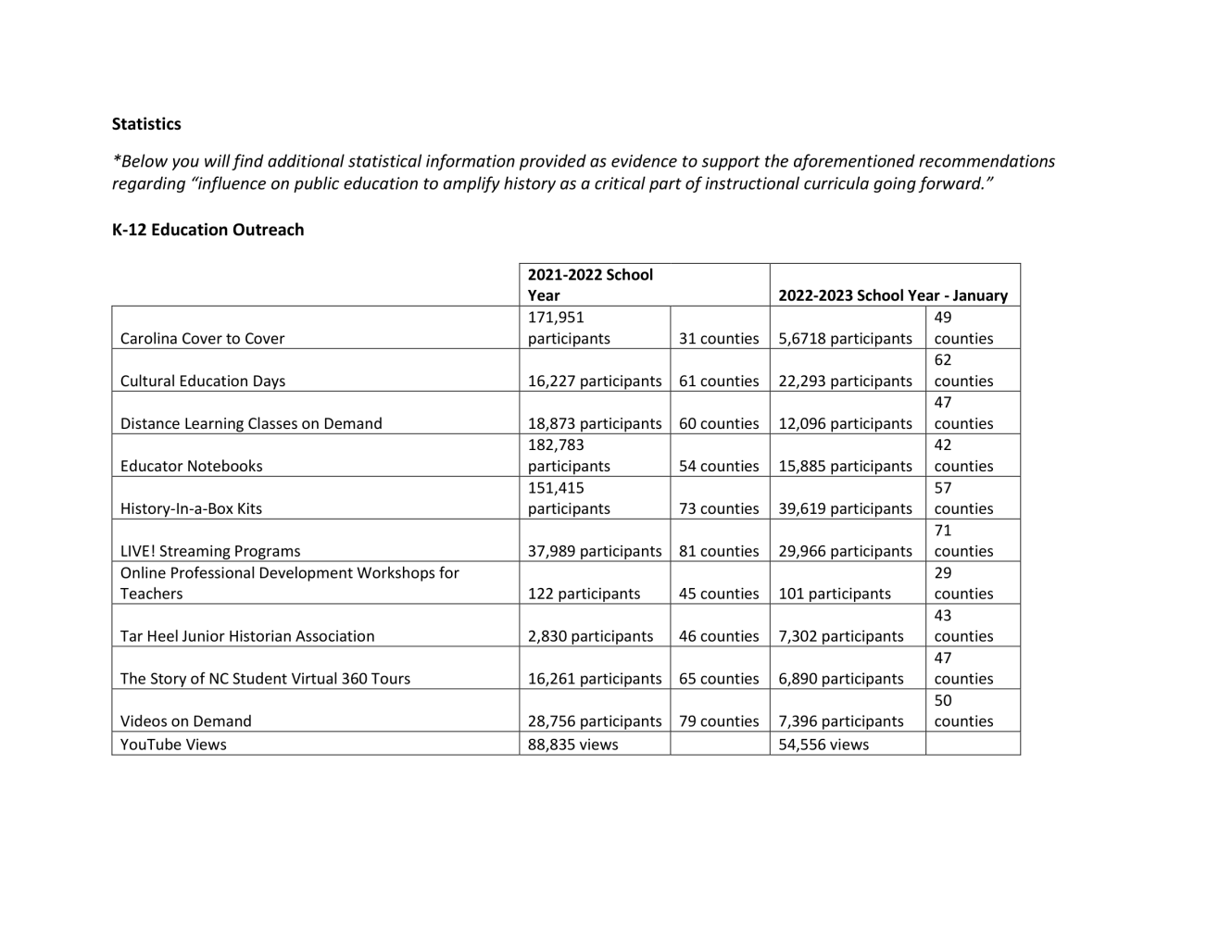
*Below you will find additional statistical information provided as evidence to support the aforementioned recommendations regarding “influence on public education to amplify history as a critical part of instructional curricula going forward.”
K-12 Education Outreach
| Program | 2021-2022 School Year Participants | 2021-2022 School Year Counties | 2022-2023 School Year - January Participants | 2022-2023 School Year - January Counties |
|---|---|---|---|---|
| Carolina Cover to Cover | 171,951 participants | 31 counties | 5,6718 participants | 49 counties |
| Cultural Education Days | 16,227 participants | 61 counties | 22,293 participants | 62 counties |
| Distance Learning Classes on Demand | 18,873 participants | 60 counties | 12,096 participants | 47 counties |
| Educator Notebooks | 182,783 participants | 54 counties | 15,885 participants | 42 counties |
| History-In-a-Box Kits | 151,415 participants | 73 counties | 39,619 participants | 57 counties |
| LIVE! Streaming Programs | 37,989 participants | 81 counties | 29,966 participants | 71 counties |
| Online Professional Development Workshops for Teachers | 122 participants | 45 counties | 101 participants | 29 counties |
| Tar Heel Junior Historian Association | 2,830 participants | 46 counties | 7,302 participants | 43 counties |
| The Story of NC Student Virtual 360 Tours | 16,261 participants | 65 counties | 6,890 participants | 47 counties |
| Videos on Demand | 28,756 participants | 79 counties | 7,396 participants | 50 counties |
| YouTube Views | 88,835 views | 54,556 views |
From: Lanier, Michelle <michelle.lanier@ncdcr.gov>
Sent: Wednesday, March 1, 2023, 5:40 PM
To: Waters, Darin <darin.waters@ncdcr.gov>
Subject: Re: Historical Commission recommendations
Greetings!
In communicating with our head of Education for the Division of State Historic Sites, I have surmised the following recommendations:
- We encourage a strong commitment to lifelong learning of history, beginning with preschool.
- We have seen the strength of digital humanities tools ranging from videography, livestreaming, and podcasting substantially increase accessibility to historic narratives, primary sources, and historically significant material culture.
- Public history professionals need a stronger relationship with institutions of higher learning in order to confront the challenges of the current moment.
- The educational and enrichment needs of people living with disabilities should be prioritized at every level and with every initiative.
- It is important to remember that a diversity of North Carolina's historic narratives is not a trend, it's the truth.
- More resources need to be made available for paid apprenticeships, fellowships, professional development opportunities, and leadership training in the public history fields.
- Educators of all kinds need to be engaged in the evaluation of the efficacy of our in-person and online resources.
Michelle Lanier
Director