
Junior Ranger Group Activity Guide
Group Activity Guide
North Carolina State Parks
Junior Ranger
Protect. Explore. Learn.
Junior Ranger
NC State Parks
How to become a junior ranger
Collect or "cache" acorns
To be a Junior Ranger: cache 20 acorns
Earn an official Junior Ranger patch for the park
How to cache acorns
Cache from 1-3 acorns by completing the activities in this guide. Record your cache in the space provided at the end of each activity.
- 1 = 1 acorn for this activity
- 2 = 2 acorns for this activity
- 3 = 3 acorns for this activity
How to Receive your Patches:
- Your group must cache at least 20 acorns each.
- Recite the Junior Ranger pledge together (see page 14).
- Email Brittany Bartholomew (brittany.bartholomew@ncparks.gov) and include:
- your mailing address
- the park you visited
- the number of Junior Rangers in your group
- any photos you took of the Junior Rangers in action and/or any of the artwork they created in this book
- You will receive your patches in the mail!
Please note: this process can take up to 2 months. Any photos sent will be added to the next Junior Ranger Newsletter.
Visit ncparks.gov/education/junior-ranger-program to sign up for the quarterly newsletter.
Park safety tips
- Always have an adult with you
- Bring water and snacks
- Stay on trails
- Dress in layers. Wear a hat and closed-toe shoes
- Apply bug spray and sunscreen
- Check for ticks when you get home
- Don’t feed wildlife. Report sick or injured animals to park staff.
- Learn what poison ivy looks like - leaves of three, let it be!
About
________________________________________________________
Name of State Park or State Recreation Area
Did you know that you would have to travel all the way from Canada down to Florida to experience all the ecosystems that you can find right here in North Carolina? There are over 40 NC State Parks where you can explore all of these beautiful ecosystems. Each park has features that make them special and unique. As you are exploring your park, find out what makes it special.
Answer the questions about your park below to cache 5 acorns!
What are three things that make this park special?
- _________________________________________________________________
- _________________________________________________________________
- _________________________________________________________________
How did the park get its name? ______________________________________
___________________________________________________________________________
_____________________________________________________________________
Draw a star on the map of NC to show the location of the park you're visiting:
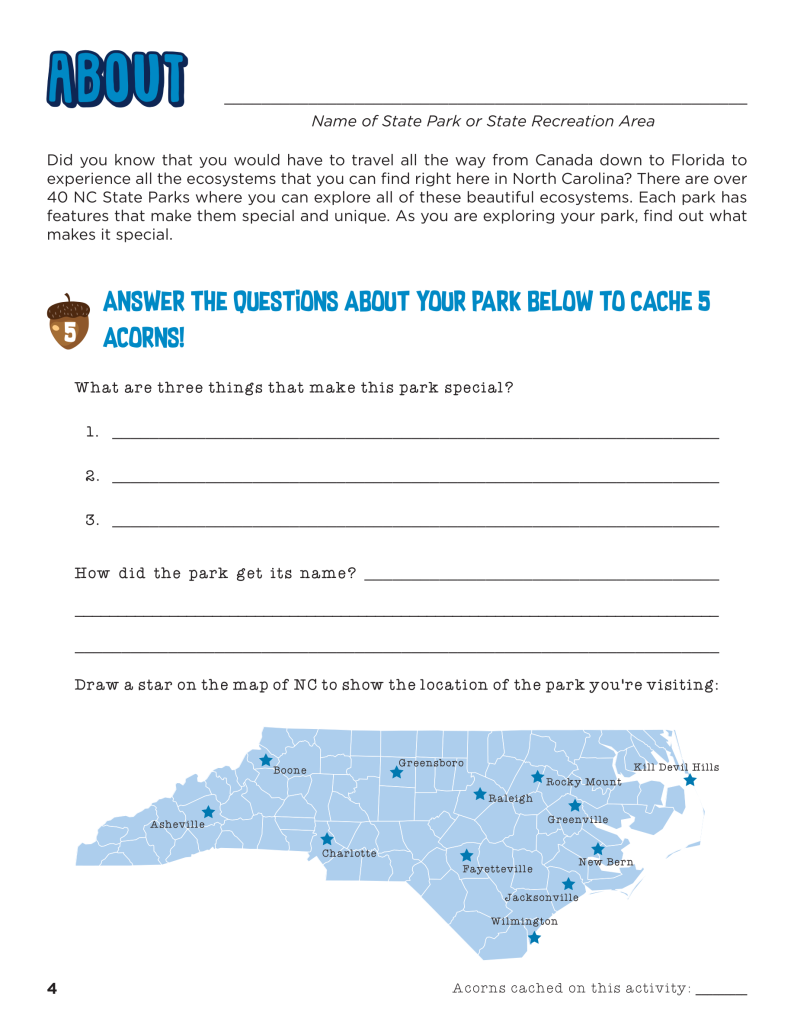
- Kill Devil Hills
- Rocky Mount
- Greenville
- New Bern
- Jacksonville
- Wilmington
- Fayetteville
- Charlotte
- Greensboro
- Raleigh
- Asheville
- Boone
Acorns cached on this activity: _________
Explore the park
Get a copy of the park’s map. Use the map’s legend to help you locate the hiking trails, water, picnic areas, bathrooms and roads.
Hike a trail! Cache 3 acorns for each mile you complete!
_______ miles x 3 = ________
- As you explore, find one special spot. Draw a picture of your spot in the box below.
- Answer the questions below about your spot:
- Describe your spot. What makes it special? Is it sunny or shady? What do you see? What do you hear?
_______________________________________________________________________
_______________________________________________________________________ - How did you get to your special spot? What trails did you take? What was the color and shape of the trail blaze? How long was the hike?
_______________________________________________________________________
_______________________________________________________________________ - What are your first impressions of your spot? How does being in your special spot make you feel?
________________________________________________________________________
_______________________________________________________________________
- Describe your spot. What makes it special? Is it sunny or shady? What do you see? What do you hear?
Acorns cached on this activity: _________
About park rangers
North Carolina Park rangers do a variety of jobs in the park and use many tools to help them complete their daily tasks. Draw a line from the picture of the tools to the name of the tool and then to the job they help complete.
Tools:
- Chainsaw
- Badge
- Binoculars
- Hiking boot
- Trash grabber
- First Aid Kit
- Chalkboard (Nature)
Jobs:
- Forester
- Teacher
- Bird Watcher
- Park Cleaner
- Police officer
- Park Doctor (first Responder)
- Patroller
Continue this activity on the next page
Animal signs
Often it’s difficult to find animals in the park, so how do we know they are there? By the things that they leave behind, called “animal signs.”
- Be a wildlife detective! See how many animal signs you can find from the list below.
- Animal tunnel
- Spider Web
- Scat/Droppings
- Insect chewed leaf
- Feather
- Bird's nest
- Animal chewed pincecone
- Animal Tracks
- Draw two of the signs you found in the space below and make an educated guess what animal or insect left them behind.
- 1
_____________________________________
Animal that you think left the sign - 2
_____________________________________
Animal that you think left the sign
- 1
- Acorns cached on this activity: _________
Plants
Sometimes the names we give plants have to do with how they look. Scientists sometimes name plants after their interesting characteristics. These are called the plant’s common name. In addition to the common name, all living things also have a universal name called the “scientific name,” and no matter what language you speak, it’s the same. These names are often based off of Latin and the first part of the name refers to the species’ genus which is similar to your last name. The second part is the specific species’ name, like your first name.
- Find two interesting plants or mushrooms and examine them closely. Take a photo or sketch them below. Write a description of it and come up with your own creative name for it.
- 1 _______________________________
Your creative name
________________________________
________________________________
________________________________ - 2 _______________________________
Your creative name
________________________________
________________________________
________________________________
- 1 _______________________________
- Ask park staff or look up the plant in a field guide or online using your description, make an educated guess on the two plants from your sketches.
Plant #1
Common Name:
_______________________________
Scientific Name:
_______________________________
Plant #2
Common Name:
_______________________________
Scientific Name:
_______________________________
Acorns cached on this activity: _________
Birdwatching
Birds are one of the easiest animals to find in parks because parks help to protect their habitats. There are more than 400 different kinds of birds in North Carolina! There are many ways we can tell different species of birds apart. We can look at the colors of their feathers, the shape of their bill, or listen to their call.
- Use the chart below to take notes on two different bird species.
| Observation Criteria | Bird #1 | Bird #2 |
|---|---|---|
| Location - Where is it - beach, forest, parking lot? | ||
| Bill - Shape and color? | ||
| Color - Head, back, chest? | ||
| Behavior | ||
| Other notes | ||
| Sketch |
2 Ask park staff or look up the bird in a field guide or online using your description, make an educated guess on the two birds from your chart.
Bird #1
Common Name:
_______________________________
Scientific Name:
_______________________________
Bird #2
Senses
While out in the park, use your senses to discover the natural world around you. Listed below are four of our five senses. We have left off taste because there are many plants in the park that are harmful if eaten.
Sight
Spot something beautiful and draw it here.
Sound
Sit in one spot and listen to the sounds around you for a few minutes. Afterwards create a sound map – the person in the middle is you. How many sounds were man-made versus natural?
Man-made: _______ Natural: _______
Smell
Find a unique smell and describe it. What do you think you are smelling? What does the smell remind you of?
____________________________________
____________________________________
____________________________________
____________________________________
____________________________________
____________________________________
____________________________________
____________________________________
Touch
See if you can find 4 things with very different textures. Draw them or do a rubbing of each item below.
Acorns cached on this activity: _________
Year of the Bear
Habitat Hunt:
A habitat is a place where an animal finds everything it needs to survive. For a Black Bear, finding their needs may require them to migrate across the state. Their range can be anywhere from 8 to 800 square miles. (North Carolina is only 503 miles wide by 100 miles tall). Food is a factor in how far they will migrate. Black Bears are omnivores, meaning they eat both plants and meat. But you may be surprised to know that 75% of their diet is plants. In fact they have a special gap in their teeth (called a diastema) that allows them to strip leaves off of plants.
1 Just like how a Black Bear has to hunt for their needs, use the word search below to find some of the habitat needs of a Black Bear.
W F J H G C F B Q M M E M N Y
Q F W I B O A O K X J I D H V
S M W Y S T H G Y H Q J K I R
K F B Z R I N S E C T S J J R
G I V E T H C F D J L C H D C
R S W T R W A T E R R E O N F
U H C S T R K M U M Y W N W N
B Y T V H Q I V M D R O E O M
S Z H X O E X E P C B I Y R Z
C V O G V B L N S B E C C M F
U R I Y Y L O T U B R G O S P
F U N G I V N U E T K S M H A
V L H W T R N M Y R S L B X V
J C A R R I O N G R A S S E S
K E J E G Q D R S E D G E S C
- Honeycomb
- Insects
- Sedges
- Grubs
- Berries
- Shelter
- Fungi
- Worms
- Carrion
- Grasses
- Water
- Nuts
- Fish
2 Now hike a trail and see how many Black Bear needs you can find. Put a check in the word bank below next to the ones you found.
- Honeycomb
- Insects
- Sedges
- Grubs
- Berries
- Shelter
- Fungi
- Worms
- Carrion
- Grasses
- Water
- Nuts
- Fish
Acorns cached on this activity: _________
Litter Scavenger Hunt
2 Cache 2 acorns by collecting and properly disposing of litter you find in the park. Record what you find for each category.
- Something blue: _____________________________________________
- Something plastic: ___________________________________________
- Something bigger than your nose: _______________________________
- An aluminum can: ____________________________________________
- A fast-food wrapper: __________________________________________
- Something a person lost: ______________________________________
- Something you can use again: __________________________________
- Something recyclable: ________________________________________
- Something shiny: ____________________________________________
- Something made from a tree: __________________________________
- Something smaller than a penny: ________________________________
- Something yucky: ____________________________________________
- Something that could hurt an animal: ____________________________
- Something you don’t know what it is: _____________________________
Acorns cached on this activity: _________
Journal
Use this space for writing or drawing your thoughts and feelings on your journey to become a Junior Ranger. You can also use this space if you run out of room on another page.
_____________________________________________________________________
_____________________________________________________________________
_____________________________________________________________________
_____________________________________________________________________
_____________________________________________________________________
_____________________________________________________________________
_____________________________________________________________________
_____________________________________________________________________
_____________________________________________________________________
_____________________________________________________________________
_____________________________________________________________________
_____________________________________________________________________
_____________________________________________________________________
_____________________________________________________________________
_____________________________________________________________________
_____________________________________________________________________
_____________________________________________________________________
Your pledge
Add up the acorns your group cached from each activity.
My Acorn Cache: __________
Total the acorns each Junior Ranger in your group cached to earn your park patch! Have your group recite the pledge below and congratulations! You’re an official Junior Ranger!
See page 2 to find out how to receive your group’s patches.
Find a park staff member and recite the following pledge with them:
I (your name),
recognize that this park is MY park too.
I promise to help take care of my park.
I will do what I can to help keep the park clean.
I will treat animals and plants with respect
and leave them in their park home.
I will learn about the importance of nature
and our duty to protect it,
and I will share what I learn
with my friends and family.