
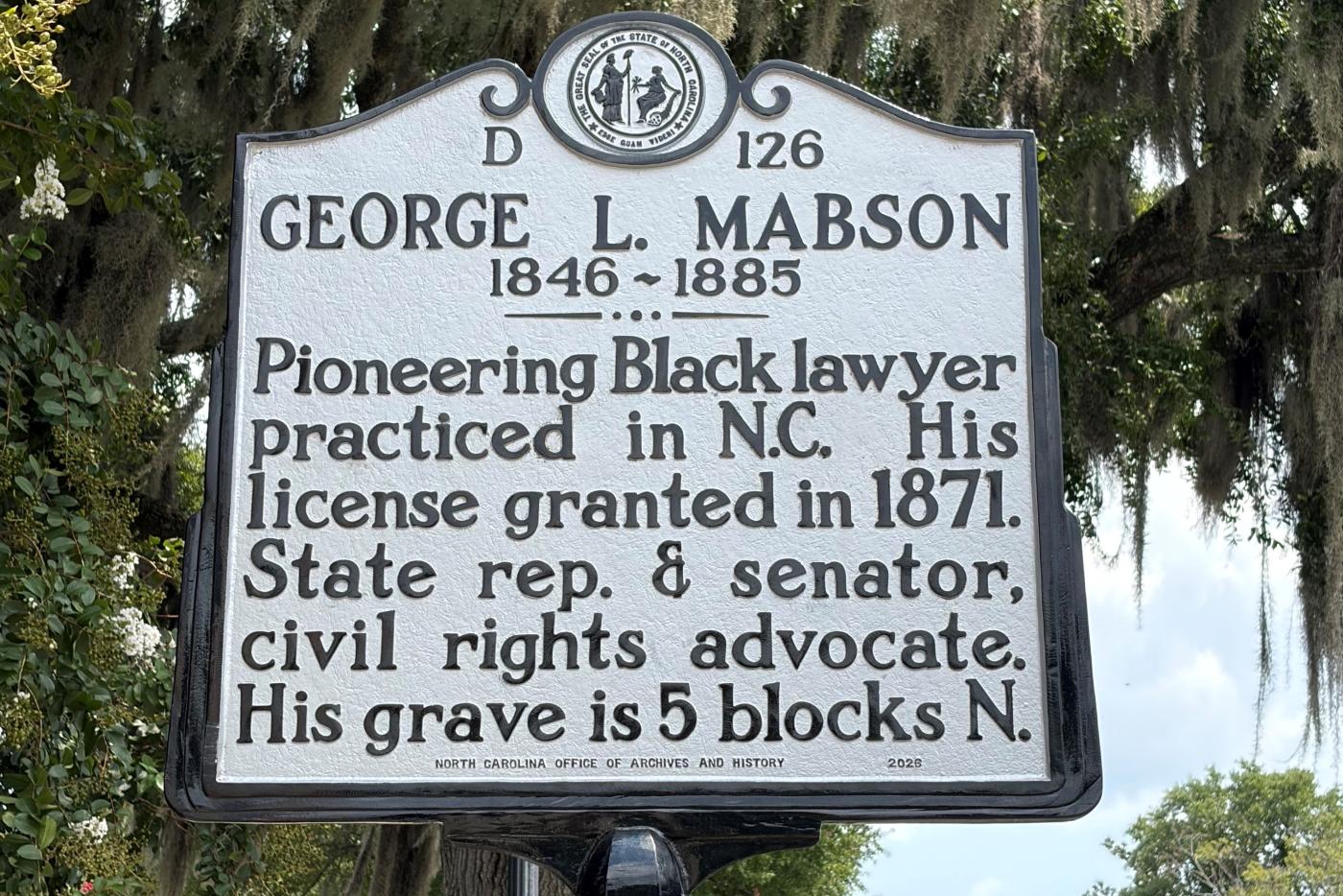
Location: Market St (US 17) and 16th street, Wilmington.
County: New Hanover
Original Date Cast: 2026
George L. Mabson occupies an important place in the history of North Carolina during the Reconstruction era. Born in 1846, he rose to become one of the first African American lawyers licensed to practice in the state. His career reflects the legal, political, and social changes that followed the Civil War and highlights how Black professionals contributed to public life during a transformative period.
Mabson received his legal education at Howard University. Like many aspiring Black attorneys in the years after emancipation, he sought credentials that would allow him to participate in the legal system that had excluded African Americans for generations. In June 1871, he and Thomas R. Warrick appealed to the Supreme Court for law licenses. Both men received approval, but Warrick soon left the state to practice in Washington, D.C., leaving Mabson as the first Black lawyer to actively practice law in North Carolina courts. Contemporary reports noted that the court had granted him his license and that he quickly appeared before local benches.
As a new lawyer in Wilmington, Mabson attracted attention. One newspaper described him as the “newly fledged colored lawyer” who had already argued a case in the local court. His admission had not been straightforward. Earlier that month, a judge refused to allow him to appear in court because he lacked a North Carolina-issued license, even though he presented his District of Columbia credentials. This incident underscores the procedural barriers African American attorneys navigated during Reconstruction.
Mabson’s influence extended far beyond the courtroom. He was deeply involved in the political life of Wilmington and the broader region. He served as a speaker at Republican meetings as early as 1867 and was regarded by some observers as a political leader among African Americans in North Carolina. He held multiple public offices, including service in the North Carolina House of Representatives from 1870 to 1872 and in the State Senate from 1872 to 1874.
Reconstruction-era Black civic life was rich and varied, and Mabson embraced many of its institutions. Reports indicate his activity in the Giblem Masonic Lodge, the Hanover Light Infantry militia unit, and the Grand Army of the Republic. He was a vice president at the 1877 African American convention held in Raleigh, which brought together community leaders to discuss political strategies during a time of increasing pressure on Black civil rights.
Mabson also had strong ties to military service. He was the nephew of William B. Gould, a Black sailor whose Civil War diary provides an important firsthand account of African American service in the Union Navy. Both men contributed to the naval war effort, which strengthened Mabson’s connection to the generation that fought for emancipation.
By the time of his death in 1885, George L. Mabson had established himself as a lawyer, politician, civic leader, and advocate for African American participation in public life. While the question of whether he was the singular first Black lawyer in North Carolina has historical complexities, his significance reaches far beyond that designation. He was part of a broader movement of African American professionals who shaped the legal and political landscape during Reconstruction and left a lasting imprint on North Carolina history.
Bibliography
“Admitted to Practice.” Daily Telegram, 18 June 1871.
Arnold, George M. “Sketch of the Hon. Geo. L. Mabson, of North Carolina.” New National Era, 29 June 1871.
Evans, William McKee. Ballots and Fence Rails: Reconstruction of the Lower Cape Fear. University of Georgia Press, 1966.
Foner, Eric. Freedom's Lawmakers: A Directory of Black Officeholders During Reconstruction. Oxford University Press, 1993.
Gould, William B. Diary of a Contraband: The Civil War Passage of a Black Sailor. Stanford University Press, 2002.
Hendricks, J. Edwin. Seeking Liberty and Justice: A History of the North Carolina Bar Association 1899 to 1999. Lexis Publishing, 1999.
“Local Dots.” Morning Star, 26 July 1871.
“Mass Meeting of the Republicans of the Fourth Ward.” Wilmington Post, 27 August 1867.
“Proceedings of the Colored Convention.” Raleigh Register, 1 November 1877.
“Proceedings of the Republican Convention of the 3d Congressional District.” Wilmington Post, 12 June 1870.
Reaves, William M. Strength through Struggle: The Chronological and Historical Record of the African American Community in Wilmington, North Carolina, 1865 to 1950. New Hanover Public Library, 1998.
Smith, J. Clay Jr. Emancipation, The Making of the Black Lawyer. University of Pennsylvania Press, 1993.