
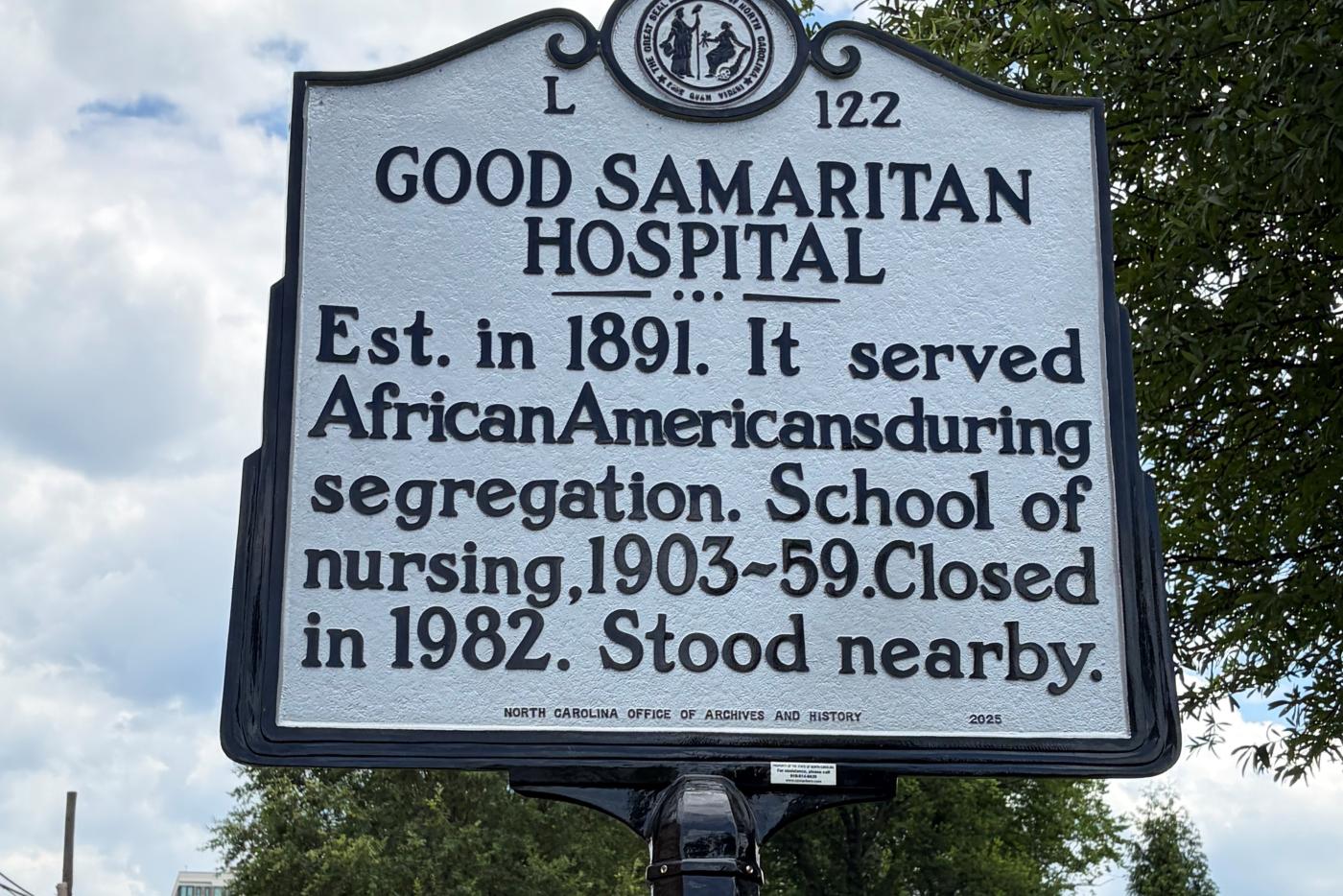
Location: in Charlotte
County: Mecklenburg County
Original Date Cast: 2025
The building housing North Carolina’s first hospital for treating Black patients stood at the corner of Mint and Graham Streets in Charlotte from 1891 until 1990.
Prior to 1876, there were no public hospitals in the state of North Carolina. Born in New York City, Jane Renwick Smedberg Wilkes relocated to Charlotte, N.C. around 1855. During the American Civil War, she treated sick and wounded Confederate soldiers as a volunteer nurse. Following the war, she became president of the Women’s Aid Society of St. Peter’s Episcopal Church in Charlotte. Recognizing the need for a non-military public hospital, she led the aid society to raise money for one. In 1876, she co-founded St Peter’s Hospital in Charlotte. This was North Carolina’s first civilian hospital for treating the underprivileged population. However, the South was segregated, and St. Peter’s was for White patients only.
In 1882 Wilkes began a campaign to raise money to establish a second hospital, this one for Charlotte’s Black citizens. Wilkes and the parishioners of St. Peter’s Episcopal Church succeeded in raising the necessary capital by 1888. They immediately purchased land for the hospital and that December the cornerstone was laid. The building was completed and Good Samaritan Hospital opened in 1891.
Good Samaritan was the first public hospital serving Black patients in North Carolina. While it could house only twenty patients, it paved the way for more North Carolina communities to open similar institutions to care for Black residents. Inspired by Good Samaritan, five years later, St Agnes Hospital opened in Raleigh, and in 1901, the Duke family funded Lincoln Hospital in Durham. Both were built specifically to treat Black patients.
A significant motivation for the White community was to maintain segregation. Separate Black hospitals were seen as a better option to creating segregated wards in existing hospitals, as was done much later. This further contributed to an increase in the socioeconomic and health gap between Black and White communities. However, the creation of Black hospitals unintentionally fostered the development of Black businesses like NC Mutual Life Insurance, and Durham's "Black Wall Street."
Due to segregation, there were no nursing schools open to Black women in North Carolina. In 1903, Good Samaritan opened a school to train Black nurses. That same year, Durham’s Lincoln Hospital also launched a school for training Black women to become nurses.
At 10:40 A.M. on July 27, 1911, Train 33 from Durham to Charlotte crashed into a freight train in front of the Hamlet, N.C. trainyard roundhouse. Like hospitals and schools, trains were segregated. Train 33 was packed with 912 Black passengers. Eighty-three of the passengers were in dire need of hospital treatment, and Good Samaritan was the closest hospital for Black patients.
Despite segregation, the Black and White Charlotte medical community came together to care for the Black patients. Doctors and nurses from all over Charlotte rushed to Good Samaritan and collectively treated the eighty-three patients. Incredibly, only three of the wounded succumbed to their injuries.
Two years later, Good Samaritan was the scene of one of Charlotte’s worst cases of racist violence. On August 21, 1913, John McNeely shot a Charlotte police officer. While he was arrested, he needed medical treatment for a gunshot wound he suffered in the exchange. Because he was a Black man, he was brought to Good Samaritan. Five days later, on August 26, a mob of thirty-five-armed White men stormed the hospital. They dragged McNeely into the street and shot him. This was Charlotte’s only public lynching. No one was arrested for the crime.
Because the hospital only had a twenty-patient capacity, it required expansion. In 1925, an addition to the facility doubled the number of patient beds. In 1936, a new wing was added that increased the hospital’s capacity to one hundred patients.
While the Black citizens of Charlotte had their own hospital, access to medical care was still unequal. Good Samaritan suffered from chronic underfunding. There was never enough money for orderlies. In addition to caring for patients, the hospital’s nurses were responsible for intakes, discharges, cleaning bedding, floors, walls, medical equipment, etc. By the 1950’s, the Black community in Charlotte dreamed of closing the doors to Good Samaritan. The goal was to desegregate the hospitals.
In 1959, the Good Samaritan medical school was closed. Two years later, the hospital was sold to the city of Charlotte. It became Charlotte Community Hospital. Like Charlotte Memorial Hospital, Charlotte Community treated both Black and White patients, however, they were treated in segregated wards.
It was not until the 1963 U.S. Supreme Court Case Simkins Vs. Moses Cone Memorial Hospital [in Greensboro] that desegregation of medical facilities really began. The case only forced some states to desegregate hospitals. The Civil Rights Act of 1964 ruled that segregation of all public buildings was unconstitutional.
The Charlotte Community Hospital became the Magnolia Rest Home in 1982. The location was eventually selected for a 75,000-seat stadium for a new National Football League team, the Carolina Panthers. The building that was once home to North Carolina’s first public hospital for the treatment of Black patients was demolished. Ericsson Stadium’s inaugural game was held on August 3, 1996. The Panthers beat the Chicago Bears 30-12. In 2004, Ericsson Stadium was renamed Bank of America Stadium.
Good Samaritan Hospital was the first hospital in North Carolina created to treat Black patients, inspiring other communities across the state to create similar facilities. It served residents from well outside of Charlotte and gained recognition for its historical significance to all the people of North Carolina.
References:
Katie Letcher Lyle. Scalded to Death by the Steam. Algonquin Books (1983).
Nicolle Montes. Civil Rights, Segregation, and Health Care. Old Dominion University. (ND). Civil Rights, Segregation, and Health Care | hlth1950-1970s.
Yen Duong. “Separate and no equal: Remembering Charlotte’s Good Samaritan Hospital.” NC Health News. (Feb 26, 2019) https://www.northcarolinahealthnews.org/2019/02/26/separate-not-equal-remember-charlottes-good-samaritan-hospital/.
Phoebe Pollitt. “Jane Renwick Smedburg Wilkes.” American History of Nursing Bulletin, Spring, 4-6 (1999). https://appstate.figshare.com/articles/journal_contribution/Jane_Renwick_Smedburg_Wilkes/30810182?file=60149768.
Brandon Lunsford. “Good Samaritan Hospital” Charlotte Museum of History. https://charlottemuseum.org/learn/articles/good-samaritan-hospital/.
Jeffery Houser. St. Peter’s Hospital, Charlotte’s First Civilian Hospital. Charlotte Museum of History. (ND). https://charlottemuseum.org/learn/articles/st-peters-hospital/.