
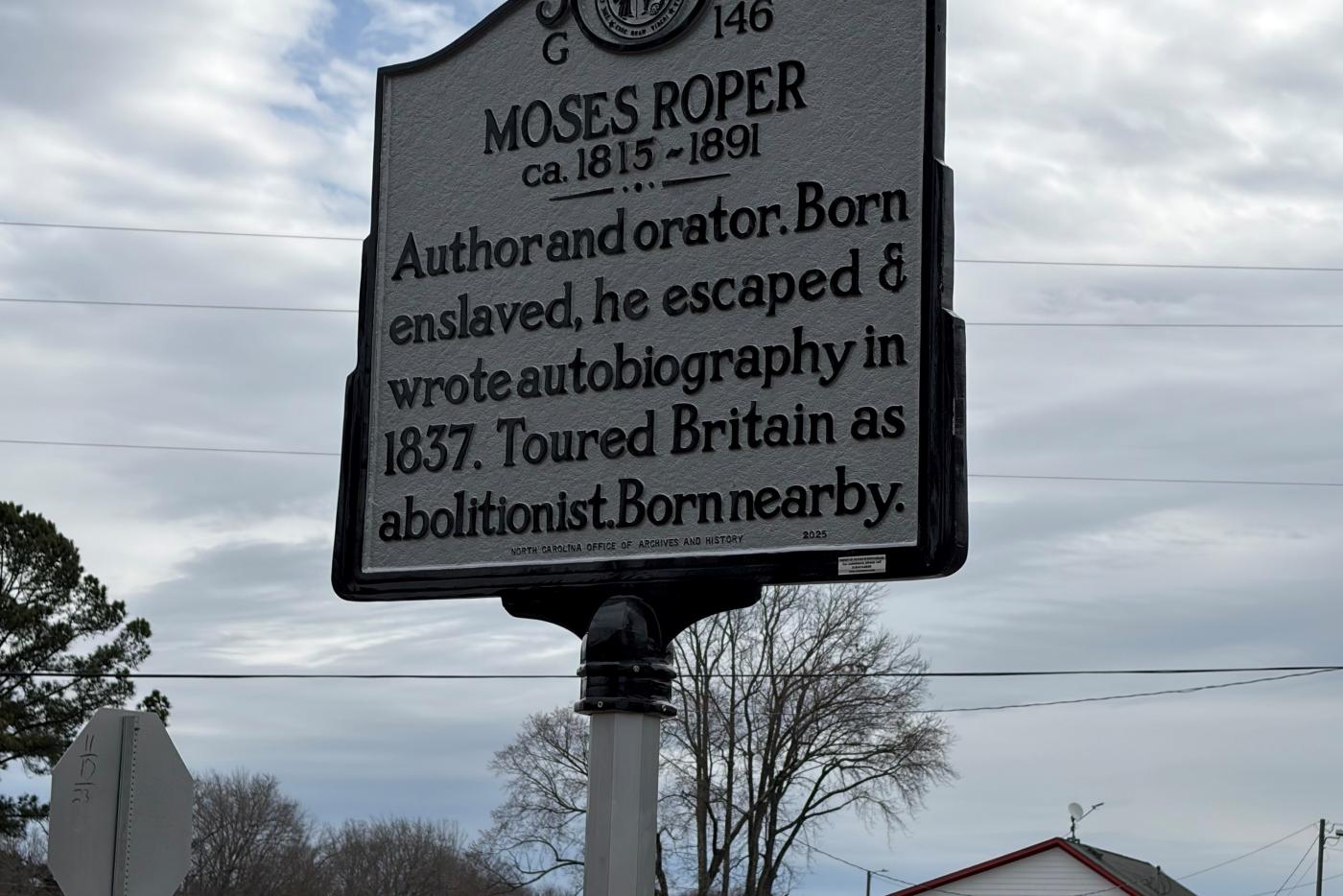
Moses Roper was born circa 1815 in Caswell County, North Carolina, the son of a mixed-race house servant and her enslaver, Henry Roper, a planter who exchanged mother and son for slaves from a neighboring plantation when Roper was six years old. As an adolescent, Roper led a nomadic existence, repeatedly being sold or traded throughout the South before he was returned to Caswell County in 1832. During the next two years, Roper made many attempts to escape, each time being punished, then sold or exchanged to some other plantation owner in the county. At the end of 1833, Roper was purchased by a north Florida trader, whose bankruptcy led to the eighteen-year-old Roper's employment as a steward on a New York-bound packet. Once anchored in New York, Roper jumped ship and ran for freedom-first stewarding a canal boat on the Hudson River, then working as a farmhand in Vermont, until he saw newspaper advertisements for his capture as a fugitive slave. Roper left Vermont and briefly settled in New Hampshire before moving to Boston. There he began his affiliation with the abolitionist movement by signing the constitution of the American Anti-Slavery Society. But by late 1835, Roper, fearful of arrest and return to slavery, signed up as a steward on the vessel Napoleon and sailed for England.
Several prominent British abolitionists assisted Roper once he arrived, especially Dr. John Morrison, John Scoble, and George Thompson, who were impressed with Roper's desire to secure an education and to serve the African missions. With the help of these British patrons and the assistance of Dr. Francis Cox, who bore a significant part of the expense, Roper successfully attended boarding schools in Hackney and Wallingford and later spent some time at University College in London during 1836. Throughout this period, Roper also attended many antislavery meetings and gave speeches on his slave experiences to people who were as impressed by his stature (Roper was 6'5") as they were by his account - an account that was one of the first given by a former slave to British reform audiences.
In the summer of 1837, Roper published a narrative of his life and used a lecture tour to promote it. The book was also printed in Philadelphia and sold in America. In 1839 Roper married an Englishwoman from Bristol; and five years later, claiming to have given "upwards of two thousand" antislavery lectures during his British stay, he moved his family (the Ropers had one child at the time) to Canada West-although he had originally hoped to use proceeds from his Narrative to finance the purchase of a farm on the Cape of Good Hope. He returned to England at least two more times, arriving in 1846 "to settle some private matters" (probably to negotiate a new printing of his Narrative) and, again in 1854, to lecture.
References
Andrews, William L., and David A. Davis, eds. North Carolina Slave Narratives: The Lives of Moses Roper, Lunsford Lane, Moses Grandy & Thomas H. Jones. The John Hope Franklin Series in African American History and Culture. Chapel Hill: University of North Carolina Press, 2010.
“Caswell County North Carolina: Moses Roper (c.1815-1891).” Caswell County North Carolina (blog), September 12, 2006. https://ncccha.blogspot.com/2006/09/moses-roper.html.
“Moses Roper, b. 1815.” Accessed February 21, 2025. https://docsouth.unc.edu/fpn/roper/bio.html.
Roper, Moses. A Narrative of the Adventures and Escape of Moses Roper, from American Slavery. Chapel Hill: University of North Carolina at Chapel Hill Library, 2011.
Sweeney, Fionnghuala, and Bruce E. Baker. “‘I Am Not a Beggar’: Moses Roper, Black Witness and the Lost Opportunity of British Abolitionism.” Slavery & Abolition 43, no. 3 (July 3, 2022): 632–67.