
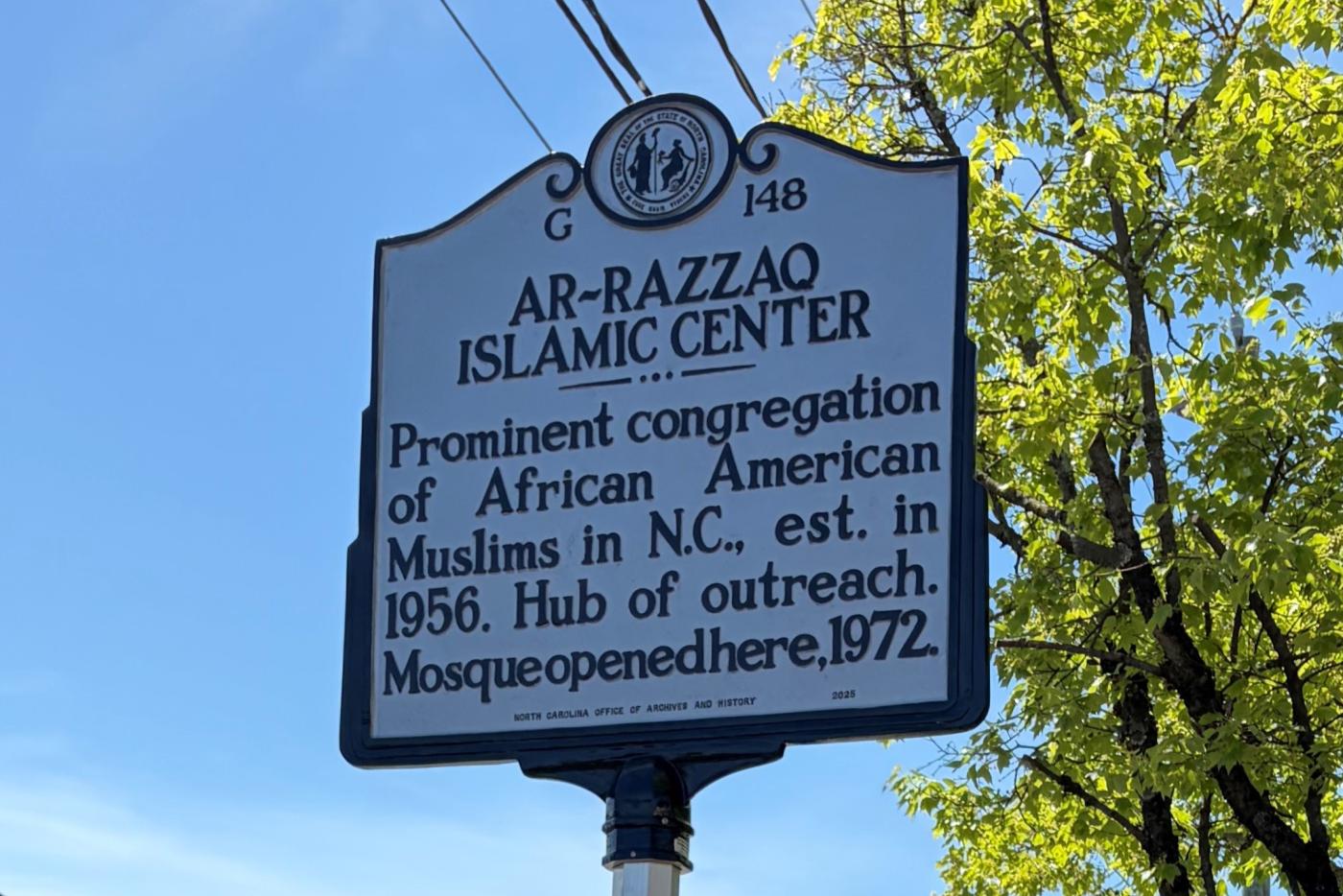
The Ar-Razzaq Islamic Center, located in Durham’s West End, holds the distinction of being North Carolina’s first mosque and a foundational institution in the state’s Islamic history. Established in 1956 as Muhammad’s Mosque #34 under the Nation of Islam, the center emerged from Durham’s growing African American Muslim community. In the 1970s, following the community’s transition from the Nation of Islam to Al-Islam, the mosque was renamed Ar-Razzaq Islamic Center. Its current location at 1009 W. Chapel Hill Street opened in 1972 and has since served as a hub for worship, education, and outreach for Muslims across North Carolina.
Ar-Razzaq’s significance extends beyond its religious function. It represents a vital chapter in the broader narrative of Black Muslim identity and activism in the American South. While much scholarly attention has focused on Black Muslim communities in northern cities such as Chicago and Detroit, Ar-Razzaq offers a rare and compelling example of how this movement took root and flourished in the South. As historian Paul Kiefer notes, the South remains an understudied region in the history of 20th-century Black Islam, despite its continuous Islamic presence since the 18th century.
Under the leadership of Kenneth (Murray) Muhammad, Ar-Razzaq became deeply embedded in the social and economic fabric of Durham’s West End. The community engaged in neighborhood revitalization efforts, including street cleaning, operating a soup kitchen, and promoting healthy eating through fish sales and dietary education. These initiatives served both Muslim and non-Muslim residents, reflecting the mosque’s broader commitment to community uplift.
Ar-Razzaq’s influence was not confined to Durham. It played a central role in the expansion of Islam throughout North Carolina. In 1971, its leaders established the state’s first Muslim school in Raleigh. The center also directly supported the founding of mosques in cities such as Raleigh, Fayetteville, Greenville, and Kinston, while offering indirect support to Muslim communities in Winston-Salem, Wilmington, Greensboro, Charlotte, Statesville, Asheville, New Bern, and Wilson. As such, Ar-Razzaq functioned as a cultural and spiritual anchor for Muslims across the state.
The mosque also attracted national attention. During the 1960s, prominent figures such as Malcolm X and Muhammad Ali visited Ar-Razzaq, recognizing its importance within the national Black Muslim movement. These visits underscore the center’s role not only in local and state history but also in the broader narrative of African American religious and political life.
Today, Ar-Razzaq Islamic Center continues to serve as a place of worship and learning. While it began as a predominantly Black Muslim congregation, it has grown increasingly diverse, reflecting the evolving demographics of Islam in the United States. As both a historical and living institution, Ar-Razzaq stands as a testament to the resilience, leadership, and spiritual vision of North Carolina’s African American Muslim community.
References
Kiefer, Paul. The Crescent Moon Rises Again in Dixie: The Black Muslim Revival in the 20th-Century South. Bachelor’s thesis, Pomona College, 2020.
Willets, Sarah. “An Exhibit at the Museum of Durham History Chronicles the Oldest Muslim Community in North Carolina.” INDY Week, August 1, 2018.