
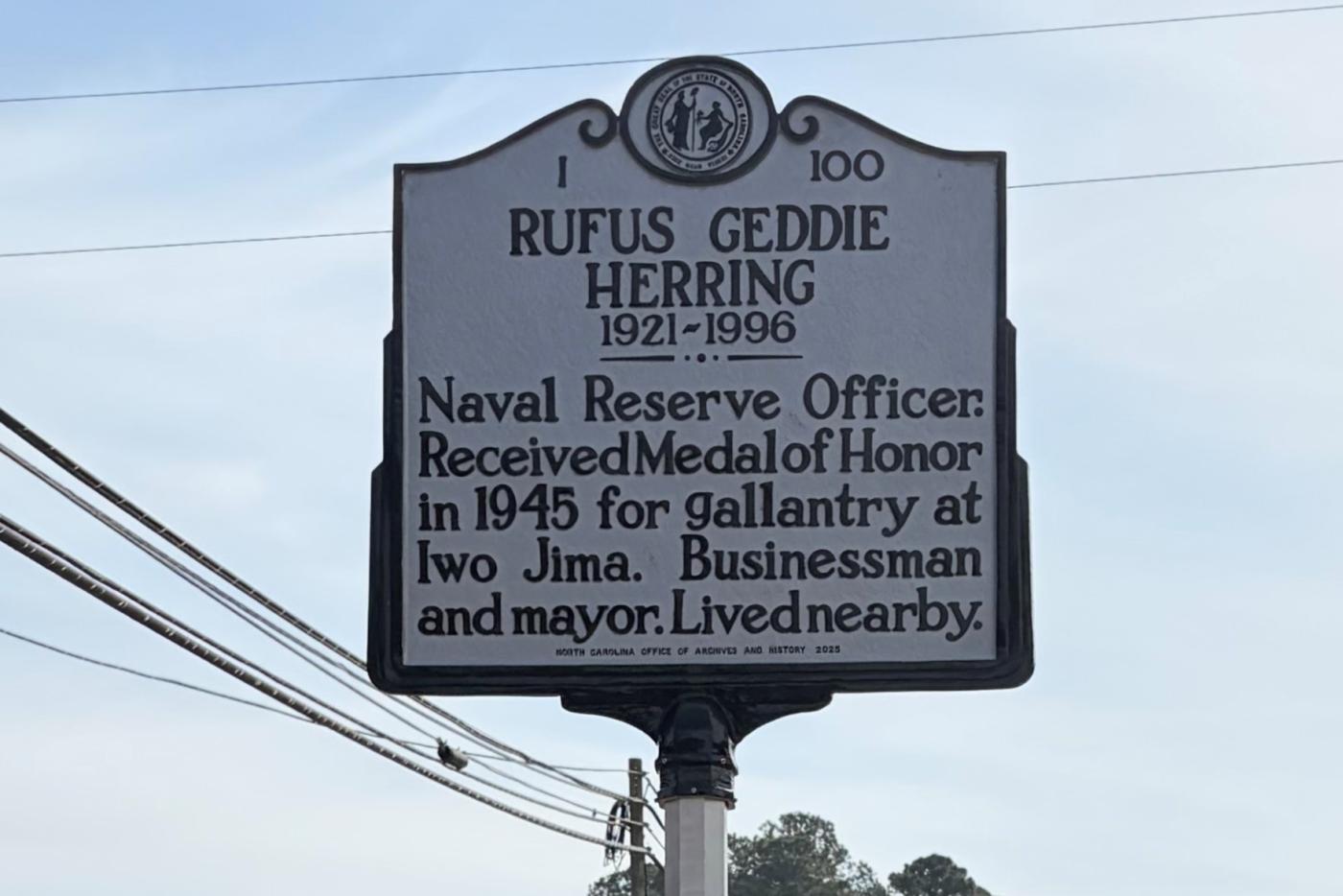
Location: 302-304 NC 24 Business Hwy (Martin Luther King Blvd.) Roseboro
County: Sampson
Original Date Cast: 2025
Medal of Honor winner Rufus Geddie Herring was born in Roseboro, North Carolina, on June 11, 1921. He graduated from Davidson College in 1942. He subsequently enlisted in the U.S. Naval Reserve. After instruction and training at the Naval Reserve Midshipmen’s School in New York City, he was commissioned as an ensign in the U.S. Navy. He received further training in the operation and maintenance of diesel engines at the University of Illinois and the Naval Amphibious Training Base in Solomons, Maryland. Upon completion of his training, he was assigned as an engineering officer to a landing craft, with the rank of lieutenant (junior grade), under the command of Lieutenant Willard Vincent Nash.
Herring trained at the Naval Reserve Midshipmen’s School in New York City, where he was commissioned as an ensign. He received further instruction in diesel engine operations at the University of Illinois and the Naval Amphibious Training Base in Solomons, Maryland. His first assignment was as an engineering officer aboard a landing craft under Lieutenant Willard Vincent Nash.
That vessel, LCI(L)-449, was a Landing Craft Infantry (Large), designed to carry up to 200 troops directly onto beaches. Built in 1943, it initially served in the Battle of Kwajalein Atoll. Later, the ship was converted into an LCI(G)—a gunboat variant equipped with heavy armament and rocket launchers to provide close fire support during amphibious assaults. After conversion, Herring and his crew fought in the battles of Saipan, Tinian, and Guam. When Nash was promoted, Herring assumed command of LCI(G)-449.
Their next mission was Operation Detachment—the invasion of Iwo Jima. This small volcanic island, located 771 miles from Japan’s mainland, was strategically vital. Japanese aircraft based there threatened American bombers, and its airstrips were essential for U.S. fighter escorts. Capturing Iwo Jima would give the Allies a critical foothold for the final push toward Japan.
On February 17, 1945, two days before the main landings, Herring’s gunboat joined the pre-invasion bombardment. Its role was to protect Underwater Demolition Teams, precursors to today’s Navy SEALs, who were clearing mines and obstacles from the beaches. As the frogmen worked, Japanese artillery unleashed a devastating barrage on the gunboats.
LCI(G)-449 was hit three times in less than five minutes. The first shell struck the bow, killing and wounding crew members, destroying the forward gun, and setting the ship ablaze. A second blast rocked the gun deck near the bridge, disabling more weapons and injuring Herring. A third shell tore through the bridge, blowing Herring out and leaving the vessel dead in the water. Nearly 60 percent of the crew were killed or wounded.
Despite severe injuries, including a shattered shoulder, shrapnel wounds, and loss of hearing, Herring refused medical aid. He reestablished communication with the engine room, took the wheel, and directed his remaining crew to fight fires and care for the wounded. Propped against empty shell cases, he stayed at his post until the crippled vessel reached the minesweeper USS Terror. Only then did he accept treatment, collapsing into unconsciousness.
For his extraordinary courage and leadership under fire, Rufus Geddie Herring received the Medal of Honor, the nation’s highest military award. His official citation credits him with saving his ship and crew while continuing to fight despite life-threatening injuries.
Herring never returned to active duty. He was promoted to lieutenant commander in 1947 and retired that same year. Back home in Roseboro, he built a successful business career and served as mayor from 1947 to 1950. In 1995, Governor Jim Hunt honored him with the Order of the Long Leaf Pine, one of North Carolina’s highest civilian awards. Herring passed away on January 31, 1996.
His legacy endures. In 2018, the North Carolina Board of Transportation named a section of Highway 24 through Roseboro the “Lieutenant Commander R. Geddie Herring Highway.” It stands as a lasting tribute to a man whose bravery at Iwo Jima exemplified the very best of American service and sacrifice.
References
Berendt, Chris. “Highway Honor for Herring.” Sampson Independent, December 5, 2017. Highway Honor for Herring | Sampson Independent.
Jordan, Chase. “Vet, Former R’boro Mayor to be Honored.” Sampson Independent, November 10, 2018. Vet, Former R’boro Mayor to be Honored | Sampson Independent.
Naval History and Heritage Command. H-Gram 0-42: The Battle for Iwo Jima, February-March 1945 and Attachment 1: Samuel J. Cox, “‘Nightmare in Hell’ – The Battle of Iwo Jima, February-March 1945,” February 20, 2020. H-Gram_042.pdf.
Newcomb, Richard F. Iwo Jima. 1965.
North Carolina Department of Transportation. “Resolution for LCDR Rufus Geddie Herring,” May 3, 2018. BOT_Resolution_GeddieHerring_web.pdf.
Rigg, Bryan Mark. “Rufus Herring.” Rufus Herring | Bryan Mark Rigg.
Ross, Bill D. Iwo Jima: Legacy of Valor. 1985.
“Six Eastern Carolina Youths Commissioned Ensigns at New York Ceremony.” News & Observer (Raleigh), December 3, 1942.
USS Landing Craft Infantry National Association. “LCI Facts.” LCI Facts – USS Landing Craft Infantry National Association.
Weiss, Mitch. The Heart of Hell: The Untold Story of Courage and Sacrifice in the Shadow of Iwo Jima. 2016.
Wheeler, Richard. Iwo. 1980.