
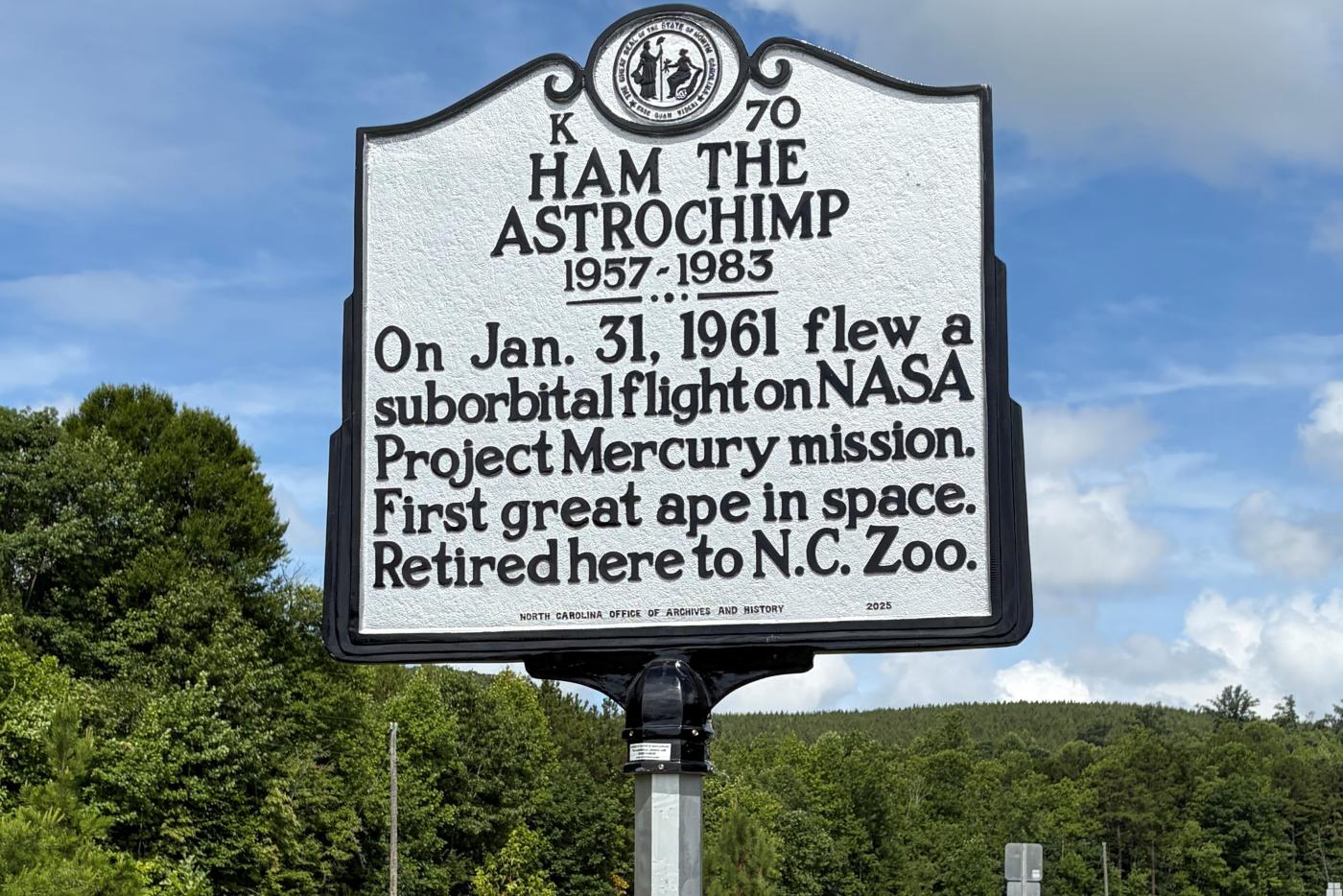
Ham the Astrochimp was a chimpanzee and the first hominid launched into space. On January 31, 1961, Ham flew a suborbital flight on the Mercury-Redstone 2 mission, part of the U.S. space program's Project Mercury. Ham's name is an acronym for the laboratory that prepared him for his historic mission, the Holloman Aerospace Medical Center, located at Holloman Air Force Base in New Mexico.
Ham was selected for intensive training at Holloman Air Force Base in 1959. Chimpanzees were chosen due to their cognitive abilities and physiological similarities to humans, making them ideal candidates for simulating astronaut performance. Ham’s training regimen involved operant conditioning techniques, requiring him to respond to visual stimuli and manipulate levers to receive food rewards. These tasks were designed to assess whether learned behaviors could be maintained under conditions of acceleration and microgravity. The ability to perform such tasks under stress was essential for validating the feasibility of human-controlled operations in space.
Ham’s flight aboard a Mercury capsule, propelled by a Redstone rocket, lasted approximately 16 minutes and reached an altitude of 157 miles, achieving speeds exceeding 5,800 miles per hour. Despite experiencing unexpected g-forces and a trajectory deviation, Ham successfully executed his assigned tasks, demonstrating that cognitive and motor functions could persist in space. This outcome was instrumental in confirming the feasibility of human spaceflight, directly influencing the design and safety protocols for Alan Shepard’s mission four months later. The physiological data collected during Ham’s flight, such as heart rate, respiration, and stress responses, provided NASA with critical insights into the biological effects of space travel.
Ham’s mission occurred during the height of the Cold War, when the United States and the Soviet Union were locked in a technological rivalry known as the Space Race. The Soviets had already launched Laika, a dog, into orbit in 1957, and Yuri Gagarin would become the first human in space just months after Ham’s flight. Against this backdrop, Ham’s successful mission was not merely a scientific milestone but also a geopolitical statement, signaling American progress toward manned space exploration. His flight reassured policymakers and the public that the U.S. was closing the gap with Soviet achievements.
Following his historic flight, Ham became a symbol of scientific progress. Initially housed at the National Zoo in Washington, D.C., he later retired to the North Carolina Zoo in Asheboro, where he lived until his death in 1983. His remains were interred at the International Space Hall of Fame in Alamogordo, New Mexico, underscoring his enduring significance in aerospace history.
References:
“Astrochimp Ham’s Retirement Years in Asheboro.” NC Department of Natural and Cultural Resources. 25 September 2016. https://www.dncr.nc.gov/blog/2016/09/25/astrochimp-hams-retirement-year…
Bandel, Jessica. “Project Mercury,” in North Carolina and the Space Race, North Carolina Historical Publications Office, MosaicNC.org (2019). https://mosaicnc.org/space-race-1
Brown, Dan. “Chimp’s Space Ride Paves Way for Man: Animal’s Condition is Good.” Miami Herald. 1 February 1961.
Cosgrove, Ben. “LIFE With the Astrochimps: Early Stars of the Space Race.” TIME, 20 November 2013. https://time.com/3456378/life-with-the-astrochimps-early-stars-of-the-s…
Kirkpatrick, Karie. “Ham the Astrochimp: Another National Zoo Celebrity.” Zoo Walks Through History, 19 December 2018. https://zoohistories.com/2018/12/19/ham-the-astrochimp/
Hackney, Rod. “U.S. Space Pioneer: Ham Dies in Zoo.” News and Record (Greensboro, NC). 19 January 1983.
“Mercury Primate Capsule and Ham the Astrochimp.” National Air and Space Museum, 10 November 2015. https://airandspace.si.edu/stories/editorial/mercury-primate-capsule-an…