A unique land exchange agreement between the State of North Carolina and Anderson Automotive Group is set to bring much needed improvements to William B. Umstead State Park, the Division of Parks and Recreation — part of the Department of Natural and Cultural Resources — announced.
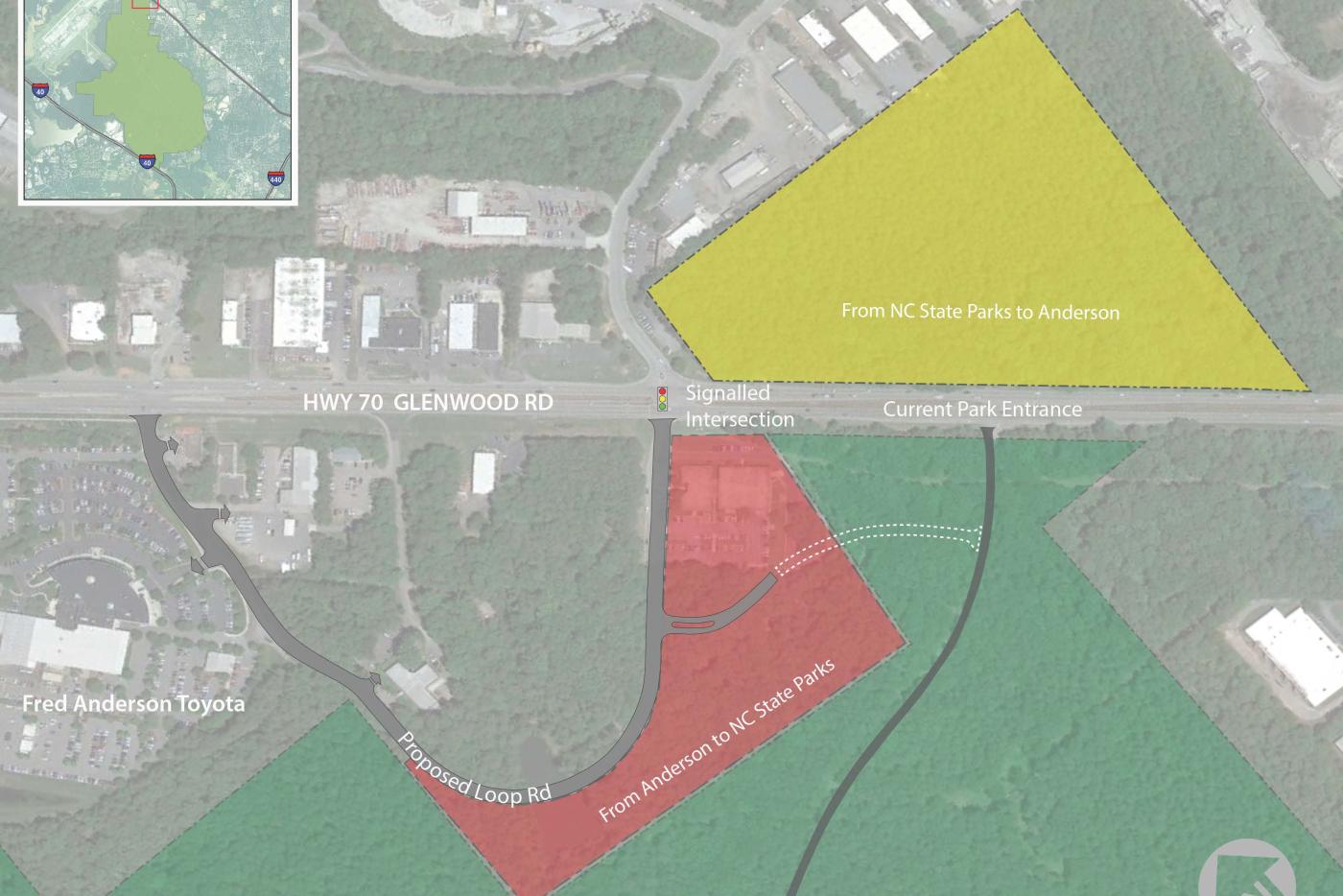
The land exchange paves the way for the relocation of the busy state park's main Glenwood Avenue entrance a few hundred yards northwest to the traffic light at the intersection of Glenwood Avenue and Triangle Drive. The relocation will make it safer for visitors to enter and exit at Crabtree Creek Access, which was utilized by nearly 50,000 vehicles in 2025. Currently, vehicles making a left turn out of the park must traverse a four-lane busy highway, making the egress particularly challenging for school buses on a park field trip and equestrian visitors hauling horse trailers.
The State Property Office with the North Carolina Department of Administration has been working with State Parks for the past 8 years to coordinate this land exchange between the parties. As part of the agreement, Anderson acquired 23 acres of parkland across Glenwood Avenue that was inaccessible to the public. In turn, the park will receive three tracts totaling 26 acres located adjacent to the northern and southeast borders of the park, including 13 acres that will serve as the new entrance.
Umstead State Park originated from land acquired by the federal government and conveyed to the state at no cost in 1943 with the requirement to be preserved as a public park. Because the land given to Anderson was deeded from the federal government, the National Park Service required the state to receive "like property." State Parks used funds from Anderson — supplemented by funding from the North Carolina Parks and Recreation Trust Fund — to purchase two additional properties also adjacent to the state park, expanding the park's acreage to just over 5,600 acres.
The new entrance will benefit trailer and RV campers who utilize the park's campground, which is set to reopen later this spring after a major construction project to upgrade the facilities.
"This project has been several years in the making, and we are so grateful to our partners at the National Park Service, Anderson, the State Property Office, and the N.C. Department of Transportation, as well as our neighboring landowners who have made this possible," said State Parks Director Brian Strong. "This will be a huge improvement that will make it easier and more convenient to access the urban retreat that is William B. Umstead."
About the State Property Office
Part of the NC Department of Administration, State Property manages property transactions on behalf of state agencies through deeds, leases, easements, licenses, eminent domain, or otherwise. It also administers North Carolina’s unappropriated and submerged lands. The office maintains an inventory of state-owned lands and buildings, as well as leased spaces for use by state agencies.
About the North Carolina Division of Parks and Recreation
The North Carolina Division of Parks and Recreation exists to inspire all through conservation, education, and recreation, with a vision to connect generations with nature through exceptional outdoor experiences. The state parks system features 35 state parks, 25 state natural areas, four state recreation areas, seven state lakes, four Natural and Scenic Rivers, and 15 state trails — spanning over 264,000 acres of iconic landscapes and welcoming 18 million visitors annually.
In addition to overseeing the state parks system, the division administers federal and state parks and trails grants, including the state-funded Parks and Recreation Trust Fund, the Complete the Trails Program, and the Great Trails State Program, as well as the federally funded Recreational Trails Program and the Land and Water Conservation Fund. The division is part of the North Carolina Department of Natural and Cultural Resources.
About the North Carolina Department of Natural and Cultural Resources
The N.C. Department of Natural and Cultural Resources (DNCR) manages, promotes, and enhances the things that people love about North Carolina – its diverse arts and culture, rich history, and spectacular natural areas. At more than 100 sites across the state, the department enhances education, stimulates economic development, improves public health, expands accessibility, and strengthens community resiliency. For more information, please visit www.dncr.nc.gov.