
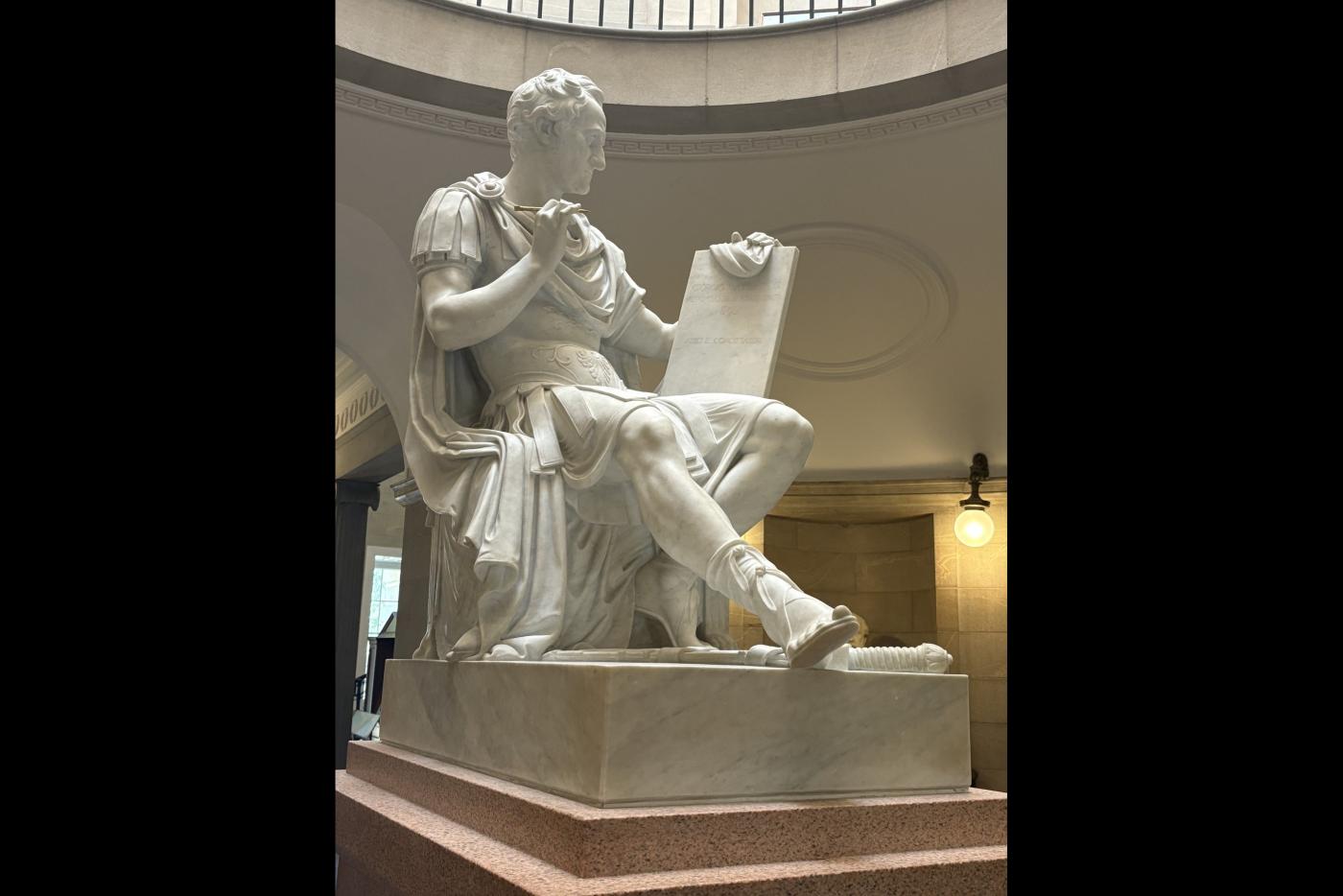
During January, the North Carolina State Capitol will be offering a new Saturday tour. The “New Year, Ancient Ideas” tour explores how ancient Greek and Roman culture influenced modern North Carolina and the United States.The tour will examine ancient symbolism in art and architecture, citizenship and voting, government, science and mathematics, and many other topics connecting our distant past with the modern day. The State Capitol is administered by the Division of State Historic Sites within the N.C. Department of Natural and Cultural Resources.
The free tours will begin at noon on Jan. 10, 17, 24, and 31. Reservations are not needed and walk-ups are encouraged. Tours will take visitors outside briefly but take place primarily inside the Capitol. Tour content is appropriate for most age groups but recommended for ages 10 and older. Tours will begin in Capitol rotunda and attendees should check in at front desk upon arrival.
The Capitol is located at 1 E. Edenton St., in Raleigh. Parking is available at metered spaces around the square or in the N.C. Museum/Government Center state parking lot located at 100 E. Jones St.
The State Capitol’s mission is to preserve and interpret the history, architecture, and function of the 1840 building and Union Square. For additional information please call 984-867-8340 or visit https://historicsites.nc.gov/capitol.
About the North Carolina Department of Natural and Cultural Resources
The N.C. Department of Natural and Cultural Resources (DNCR) manages, promotes, and enhances the things that people love about North Carolina – its diverse arts and culture, rich history, and spectacular natural areas. At more than 100 sites across the state, the department enhances education, stimulates economic development, improves public health, expands accessibility, and strengthens community resiliency. For more information, please visit www.dncr.nc.gov.