
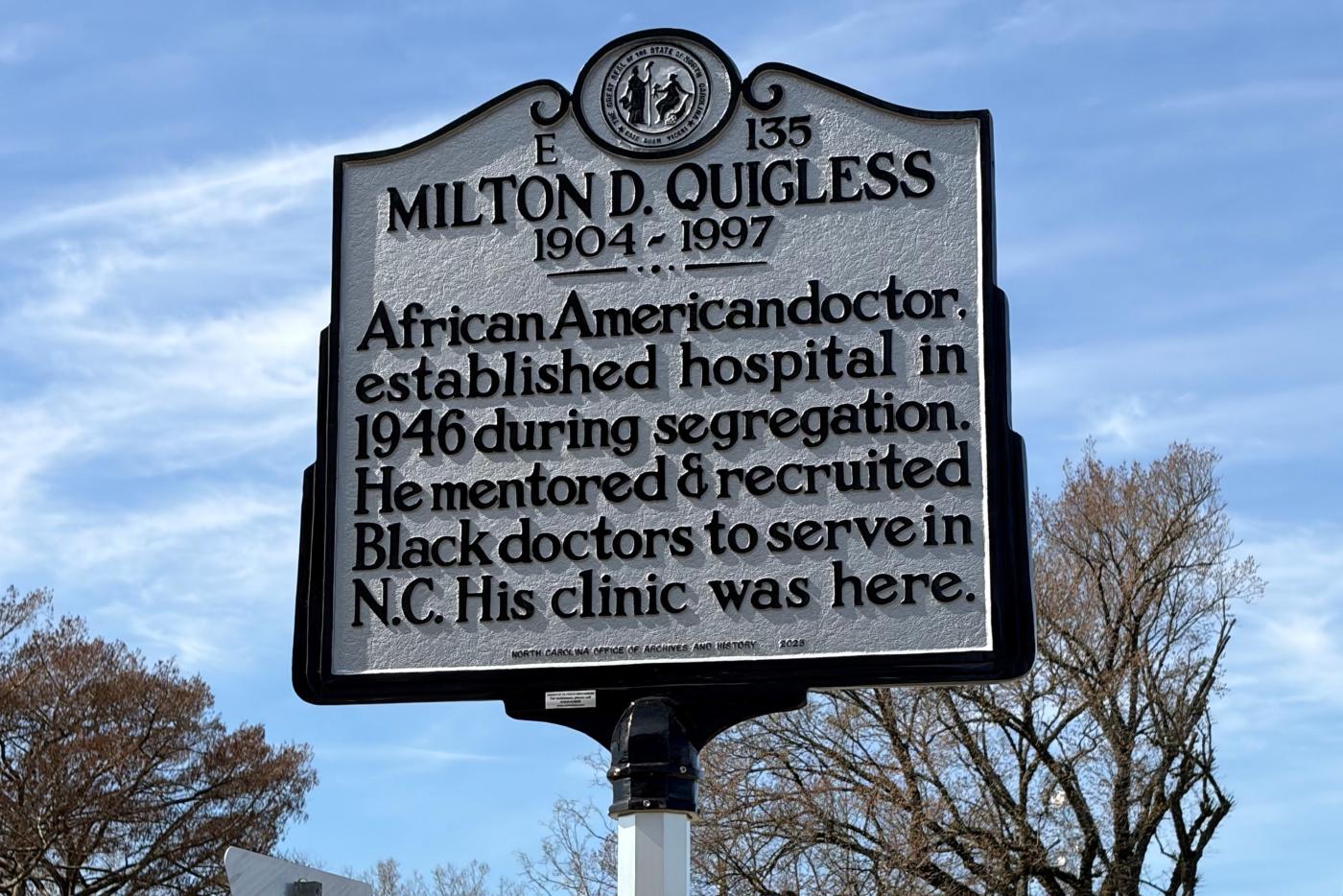
Location: 99 North Main St. Tarboro
County: Edgecombe
Original Date Cast: 2025
Milton D. Quigless Sr. was born in Port Gibson, Mississippi in 1904. After graduating from Meharry Medical College in Nashville, Tennessee, he moved to Tarboro, North Carolina in 1936. Dr. Quigless arrived at a time when Black residents faced terrible healthcare conditions; as he later said, “The white doctors treated them like they were dogs.” The town’s previous Black doctor, Alexander McMillan, had died a few years earlier, and the white-controlled Edgecombe Memorial Hospital denied Dr. Quigless hospital privileges due to the segregationist racial policies of the Jim Crow era.
For the next ten years, Dr. Quigless treated people in their homes, often with improvised medical equipment. By 1945, he decided to open his medical clinic due to his frustration with the barriers that Jim Crow laws and customs imposed on his medical practice and the threat that it posed to the well-being of his patients. After several Tarboro banks denied him loans, Peoples Bank in Rocky Mount loaned him money to construct his facility at the site of an old fish market that had served as his office. The Quigless Clinic also referred to as the Quigless Clinic-Hospital, opened for patients in December 1946. The only hospital for Black patients at that time in Edgecombe and Nash Counties, it was a two-story building that served both as a medical clinic and a twenty-five-bed hospital. The hospital and its operating room were furnished with World War II military surplus medical equipment. Many of his patients were not only Black but poor, including local tenant farmers who had previously only limited access to professional health care if at all.
Dr. Quigless soon gained a wide reputation as a skilled physician, treating skin diseases, arthritis, asthma, weight control, hair loss, and allergies. He also set broken bones, performed appendectomies, and delivered babies. He mixed his own drug recipes in his licensed in-house pharmacy. He was known to sometimes adopt unorthodox treatment methods, such as his using estrogen injections to treat a hemophiliac. Although reportedly successful in the case of this one patient and according to one source subsequently studied by the University of North Carolina Medical School, Quigless’s methods have not been adopted or endorsed by the medical profession. Due to these aspects of his practice, Quigless has sometimes been understood as having practiced in the areas of natural health and herbology, but according to his daughter Carol in her epilogue to her father’s autobiography and herself a practitioner of such methods, her father disdained them.
Throughout the early years of his practice and the operation of the clinic, Quigless continued to battle racial hostility from the local white medical establishment after the opening of his clinic. Gradually he began to take on an activist role in the community. He was a charter member of the East Tarboro Citizens League, which sought to organize the city’s Black citizens to improve their lives in the areas of political involvement and representation, education, housing, and economic opportunity.
Dr. Quigless also recruited and mentored many Black doctors who practiced in eastern and central North Carolina and in other states. He also served as an officer in the state organization of Black doctors, the Old North State Medical Society, first as recording secretary and then as president.
In 1975, Quigless was faced with the challenge of renovating the clinic building to comply with the state building code, including the introduction of a sprinkler system. Given the extent of work that would have been required, Quigless decided it was time to close the clinic. Afterward, he joined the staff of Edgecombe County General Hospital. He continued to see patients out of his old office on the first floor of the old Quigless Clinic building until his death from emphysema at the age of 93 in 1997.
In the latter years of his life and after his death, Quigless received recognition for his work from a variety of admirers. In 1987, the Rocky Mount chapter of the NAACP gave Quigless their “Man of the Year” award for distinguished service. In the same year Congressman John Lewis of Georgia, a friend, paid tribute to Dr. Quigless in the U.S. House of Representatives. From 1996 to 2003, the equipment from his operating room was on display at the North Carolina Museum of History as part of its special exhibit “Health and Healing Experiences in North Carolina. The exhibit highlighted the legacy of racial discrimination in North Carolina’s healthcare system by comparing the state of equipment in the Quigless operating room with the more technically advanced equipment at the Hickory Emergency Infantile Paralysis Hospital serving white polio patients from 1944-1945, just prior to the opening of the Quigless Clinic. The Quigless Clinic building was added to the National Register of Historic Places in 2000 as a place of local historical significance. In 2004 Dr. Quigless was posthumously inducted into the Twin County Hall of Fame, an organization devoted to the history of Edgecombe and Nash Counties in connection with the Rocky Mount Event Center.
References
Heather L. Barrett, preparer, National Register of Historic Places Registration Form, Quigless Clinic, May 2000.
Heather L. Barrett, “A Tarboro Legacy: Dr. Milton Quigless,” Tar Heel Junior Historian (Spring 1997), 20-23, https://files.nc.gov/dncr-moh/quigless.pdf
John Lewis, “A Tribute to Dr. Milton Douglas Quigless, Sr.,” Congressional Record, Vol. 133, No. 177: Proceedings and Debates of the 100th Congress, First Session, November 5, 1987, E 4362.
David Perlmutt, “Doctor Found Mission in N.C. as Healer for Tarboro’s Poor,” Charlotte Observer, April 24, 1994
Milton Quigless Jr., e-mail to James Wrenn, September 12, 2023.
Milton D. Quigless Jr., “A Surgeon’s and Son’s Perspective on His Father’s Career in Medicine,” Journal of the National Medical Association, 101:2 (February 2009), 189-190.
Milton D. Quigless Sr., Looking Back: The Way Things Were: The Autobiography of Dr. Milton D. Quigless, Sr. (1994)
Interview with Milton Quigless, in William H. Chafe, Raymond Gavins, and Robert Korstad, eds., Remembering Jim Crow: African Americans Tell About Life in the Segregated South (2001).