
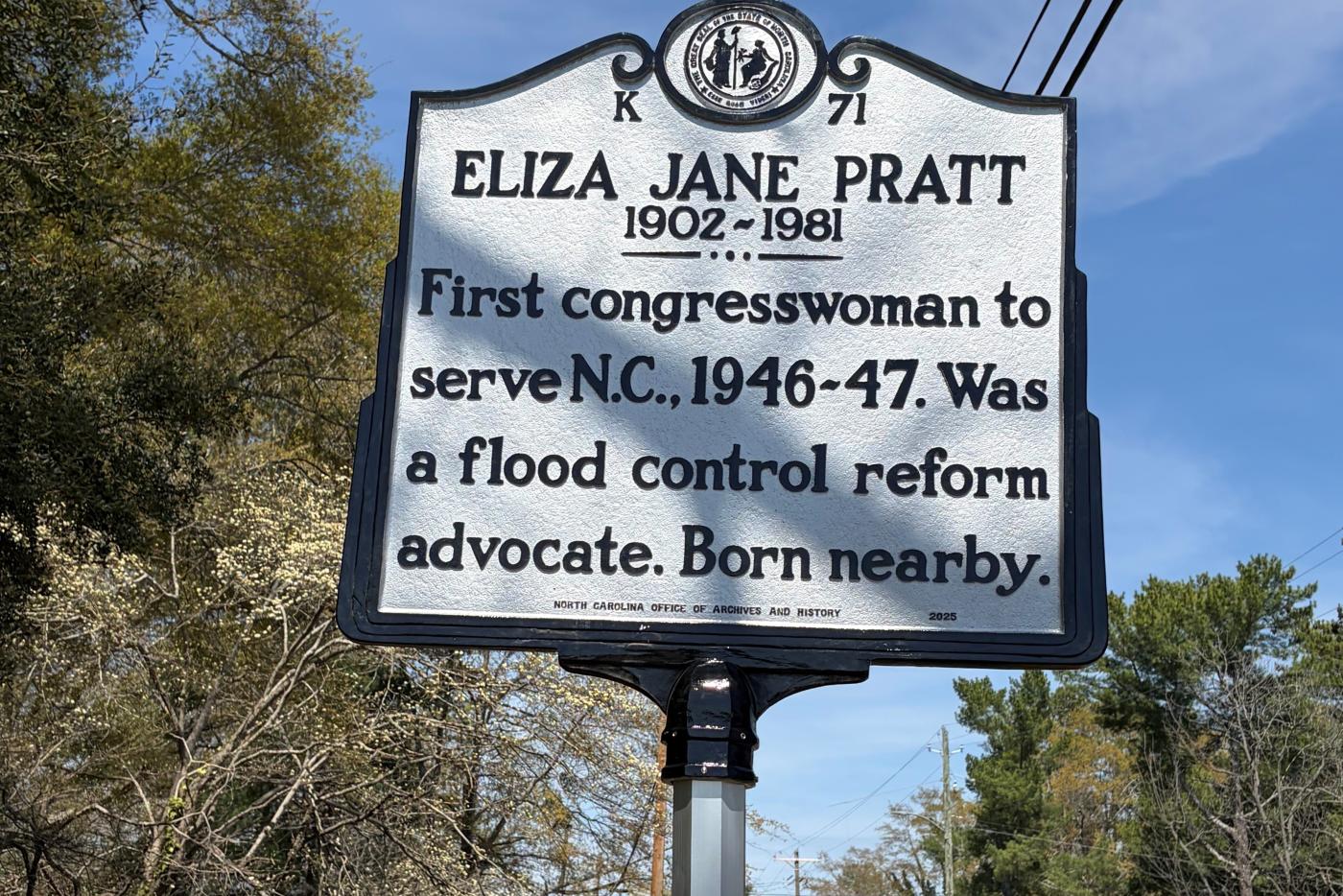
Location: Hwy 52 north of NC 145, Morven
County: Anson
Original Date Cast: 2025
Eliza Jane Pratt holds a unique place in North Carolina history as the first woman to serve the state in the United States Congress. Born on March 5, 1902, in Morven, Anson County, Pratt’s early life experiences shaped her career in public service and her brief but significant tenure as a Congresswoman. Her story reflects both the challenges and opportunities faced by women in politics during the mid-twentieth century.
Growing up in rural Anson County, Pratt witnessed firsthand the importance of agriculture to the local economy. She also observed the transformative power of technology when the Pee Dee River was harnessed to generate electricity for rural communities. These developments left a lasting impression on her, instilling an appreciation for infrastructure and modernization that would later influence her legislative priorities.
In 1911, Pratt’s family moved to Raeford, North Carolina, seeking better business prospects and educational opportunities. Her father, James Pratt, actively engaged in politics and often took young Jane to political events, sometimes distributing pamphlets. These experiences likely sparked her interest in public affairs and laid the foundation for her future career.
Pratt pursued higher education at Asheville Normal School in 1916, a teacher training institution. During her time there, she witnessed the devastating flood of the Swannanoa River, which caused extensive damage to the Asheville area. This event may have impressed upon her the importance of flood control measures, a theme that would later emerge in her congressional work. Although she studied at the Normal School for two years, Pratt decided against a teaching career and transferred to Queens College in Charlotte in 1919. Her studies were cut short in 1920 when her father’s declining health compelled her to seek employment to support her family.
Determined to succeed, Pratt learned secretarial skills at Kings Business College while working in Charlotte. Through the assistance of Addie Williams, a former instructor at Queens College, Pratt secured a position as managing editor of the Montgomerian newspaper in Troy, North Carolina. Following her father’s death in 1924, she left the newspaper and accepted a secretarial position with Congressman William Cicero Hammer in Washington, D.C. Hammer represented a district that stretched from the North Carolina mountains to the Sandhills, areas familiar to Pratt. While working for Hammer, she attended secretarial school at night, honing skills that would serve her throughout her career.
After Hammer’s death in 1930, Pratt continued working for his successors—Hinton James, John Walter Lambeth, and William O. Burgin—all Democrats. Over the next twenty-two years, she built extensive networks in Washington and maintained strong ties with constituents in North Carolina. Her reputation for competence and dedication made her a trusted figure in the district.
When Congressman Burgin died unexpectedly in office, the Democratic Party faced the challenge of filling his seat amid growing Republican strength in the mountains. Party leaders turned to Pratt, whose long service and deep knowledge of the district made her an ideal candidate. Although ill and unable to campaign actively, Pratt was nominated and won the special election with an overwhelming 80 percent of the vote, carrying all twelve counties in the district. Her campaign expenses totaled less than one hundred dollars. On June 3, 1946, Eliza Jane Pratt was sworn in as North Carolina’s first female member of Congress.
During her brief tenure, Pratt served on the Committees on Pensions, Territories, and Flood Control. She did not introduce legislation or deliver speeches, but she supported measures important to her district, including the establishment of a major flood control dam later named for Governor Kerr Scott. She also voted for the Atomic Energy Act of 1946 and supported First Lady Bess Truman’s food campaign to aid post-war Europe.
After leaving Congress, Pratt continued her public service in Washington, working for the Office of Alien Property, the Department of Agriculture, and the Library of Congress. In 1957, she returned to congressional work as secretary to Representative Paul Kitchin, a position she held until her retirement from public service in 1962. Pratt then entered the private sector as public relations head for the North Carolina Telephone Company, where she championed efforts to expand telephone service to rural areas. She also lectured at colleges and remained active in civic and political organizations until her death on May 13, 1981, in Charlotte. She was buried in Raeford City Cemetery.
Pratt’s achievement was groundbreaking, yet it would be forty-six years before another woman, Eva Clayton, represented North Carolina in Congress. Reflecting on women’s role in politics, Pratt once remarked that men had been slow to accept women as equal partners, noting that while women were active in campaigns, they were often relegated to secondary roles afterward. Her words underscore the enduring struggle for gender equality in political life.
Eliza Jane Pratt’s life exemplifies perseverance, service, and quiet leadership. From her rural roots to the halls of Congress, she navigated barriers with determination and left a legacy that paved the way for future generations of women in North Carolina politics.
References:
Deerhake, Marion. Jane Pratt: North Carolina’s First Congresswoman. Jefferson, NC: MacFarland & Co., 2024.
“Pratt, Eliza Jane.” U.S. House of Representatives History, Art, & Archives. https://history.house.gov/People/Detail/19896