
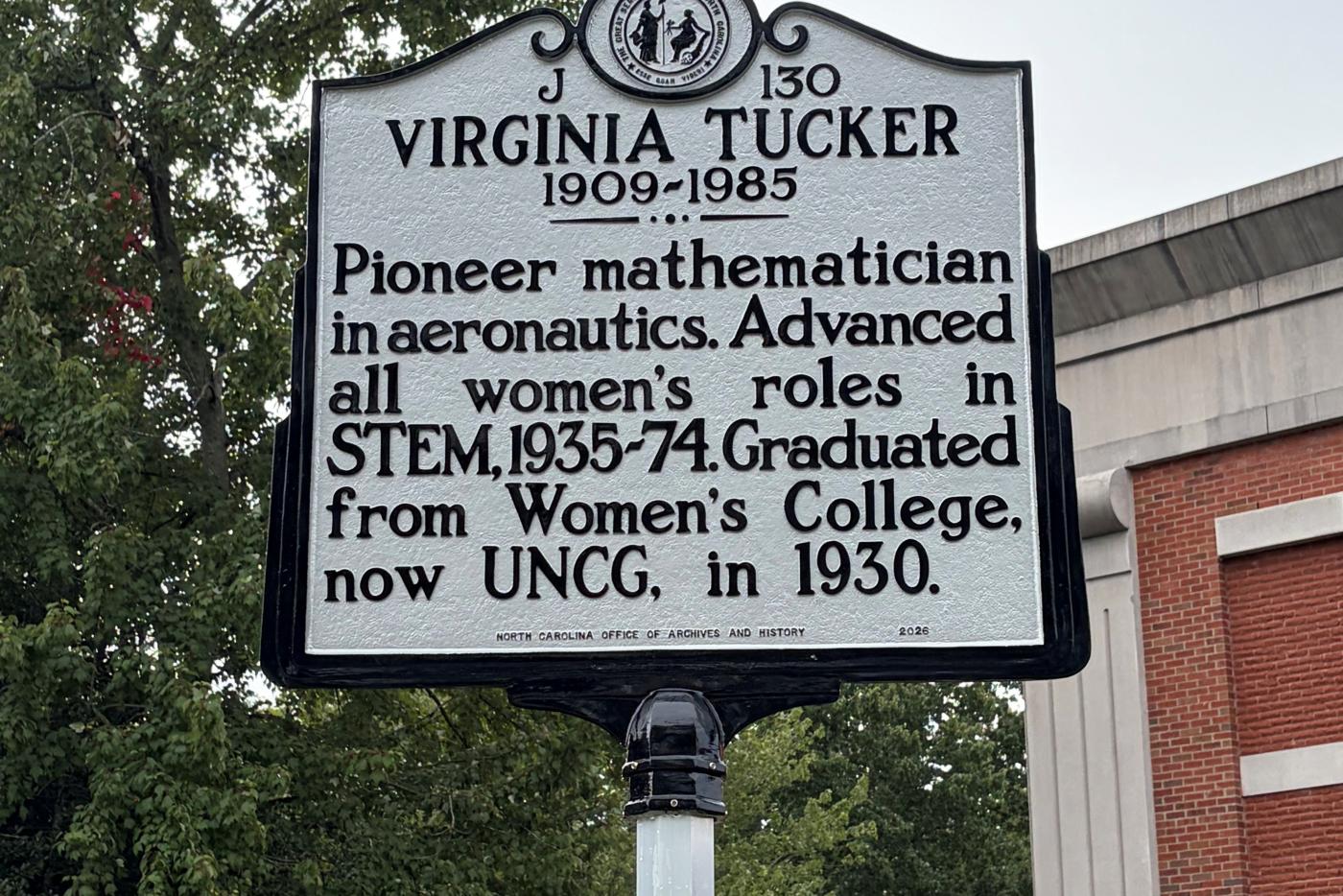
Location: Market St. and Gray Dr. in Greensboro
County: Guilford
Original Date Cast: 2026
Virginia Tucker, born in 1909 in Hertford, North Carolina, was a mathematician who significantly advanced aeronautical research and created opportunities for women in science and engineering particularly for North Carolinians. She graduated from the North Carolina College for Women (now the University of North Carolina at Greensboro) in 1930 with a mathematics degree and a minor in education.
A common career path for women at the time was to become a teacher. After graduation, Tucker taught math for four years at Perquimans High School in her hometown. When she took the Civil Service exam in 1935, her performance secured her a position at the Langley Memorial Aeronautical Laboratory, the main research center for the National Advisory Committee for Aeronautics (NACA), later NASA. Tucker was one of the first five women assigned to the newly formed human computer unit, which was expanded and renamed the West Area Computing Unit. By 1946, the West Area Computing Unit employed nearly 400 African American women.
As a computer, Tucker worked on complicated calculations essential for developing aeronautical research. During World War II, there was a higher demand for skilled mathematicians and Tucker was responsible for recruiting and training women for these important roles. She traveled to universities and women's colleges across the South, and successfully recruited many students, particularly North Carolinians. Tucker recruited entire graduating classes of mathematics majors from her alma mater.
By 1946, Tucker was promoted to Overall Supervisor for Computing at Langley becoming the most powerful woman at the lab. In this role, she oversaw the over 400 human computers and “transform[ed] the position of computer from a proto-clerical job into one of the laboratory’s most valuable assets.” Throughout her tenure, Tucker’s leadership was key to numerous aeronautical advancements and shaped the computing teams across NACA through direct involvement in experiments.
In 1948, Tucker took a position with Northrop Corporation in California as an engineer and aerodynamicist in boundary layer control. Two years later Tucker helped found the Society of Women Engineers (SWE), an organization that encouraged young women to pursue careers in engineering at a time when the United States was actively in need of technical skills. Historian Margaret Layne argued, “Early SWE members and leaders can be seen as activists working at the grassroots level to change attitudes and encourage women to seriously consider engineering and scientific careers...” For example, SWE established a speaker’s bureau and partnered with local high school guidance counselors in response to a 1953 report that indicated that young girls were actively discouraged from taking science and mathematics courses in school.
Accordingly, Tucker used her employment as an engineer to encourage young women to pursue a career within the field. Within SWE, Tucker served as director of the Los Angeles Sector and held other significant roles within the organization. While she was Vice President of the Society, she voted in favor of SWE’s anti-segregation policy at a time when the Jim Crow laws were still enforced. In support of SWE’s egalitarian ethos, Tucker advocated for the inclusion of Langley’s Black women computers into the organization. Today there are over 50,000 members in SWE and twelve active chapters in the state of North Carolina including UNC-Chapel Hill, Duke, NC State University, and Wake Forest.
After 17 years with Northrop, Tucker returned to North Carolina in 1965. She served the remainder of her career in public education as Supervisor of Instruction and Evaluation in Perquimans County before retiring in 1974. Virginia Tucker passed away on January 19, 1985.
Sources:
English, Troy Eller. “What’s Past is Prologue: The Future is Ours to Write,” Magazine of the Society of Women Engineers (Spring 2023). https://swe.org/magazine/past-is-prologue/
Gibson, Emily. “Essential, Not Supportive Women and World War II Aeronautical Research and Development at the NACA’s Langley Aeronautical Research Laboratory and Beech Aircraft Company,” in A Wartime Necessity. Alex M. Spencer, Ed. (Washington, D.C.: NASA History Office),107-119. https://www.nasa.gov/history/a-wartime-necessity/
Gorn, Michael H. Expanding the Envelope: Flight Research at NACA and NASA. Lexington: The University Press of Kentucky, 2001. EBSCOhost.
Layne, Margaret E. Women in Engineering: Professional Life. Reston, VA: American Society of Civil Engineers, 2009.
Loff, Sarah A. "When the Computer Wore a Skirt: Langley’s Computers, 1935–1970." NASA, June 28, 2024. https://www.nasa.gov/history/langleys-computers-1935-1970/
Rossiter, Margaret W. Women Scientists in America : Before Affirmative Action, 1940-1972. Baltimore: Johns Hopkins University Press, 1995.
Shetterly, Margot Lee. Hidden Figures : The American Dream and the Untold Story of the Black Women Mathematicians Who Helped Win the Space Race. First edition. New York, NY: William Morrow, 2016.